
Philip Gegan
Mass migration – We know how deadly this is for our race and nation, but what can we do about it? The obvious thing we can do for the present is to draw the attention of the wider public to what is going on, and the grotesque nightmare that awaits us and our descendants, if we fail to stop it and put it into reverse – and fast!
Thankfully, more and more people, some of them household names, are waking up to the dreadful reality of our situation. One of them is Liz Kershaw, the well-known radio DJ, who recently made the following post on social media:
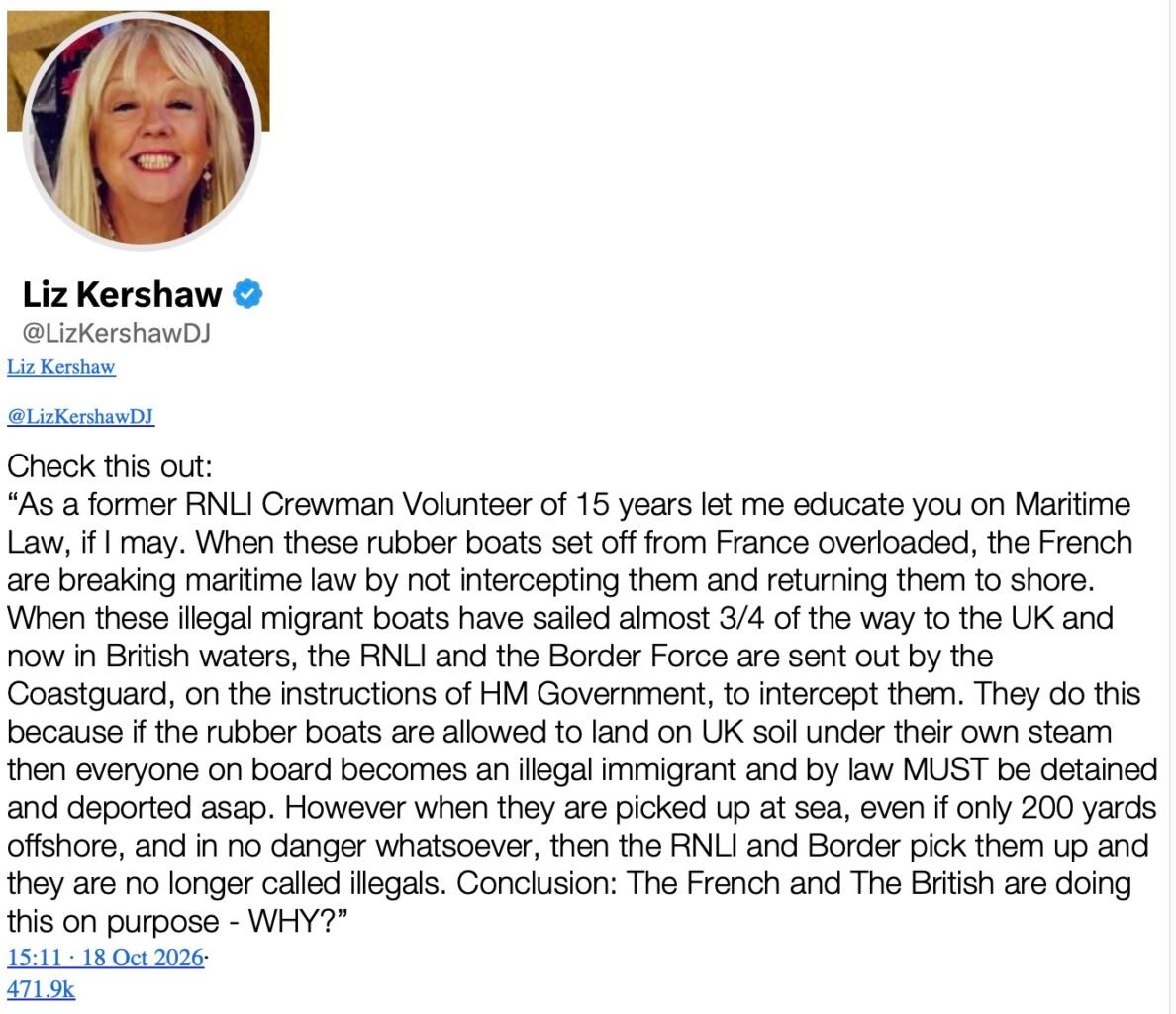
Whilst the sentiments expressed here are noble, we at Anglo-Celtic.org feel it may be a little over-simplified. We have done our own research into the exact legal position, and can report on it as follows.
The precise law on “illegal migrants” entering Britain is unclear. That, of course, is to be expected. Nearly all laws affecting matters such as immigration, nationality and “race relations” are unclear and open to multiple interpretations, and you can guess how they are interpreted by our politically correct judges as and when each case comes before them.
The legal difference between “arriving” and “entering”
There’s one thing that the English legal system is very good at, and that is “fiddling while Rome burns”.
As an example, only the English legal system could differentiate between a migrant “arriving” in the UK and a migrant “entering” the UK whilst we’re in the middle of a migration crisis that threatens our national existence. What’s the difference? Answers on a postcard.
Seriously, it seems that such a distinction has to be made on account of the 1971 Immigration Act referring to migrants “entering” the UK, and the 2022 Nationality and Borders Act referring to migrants who require “entry clearance”.
Under the 1971 Act, section 24, a migrant knowingly “entering” the UK without leave was commiting a crime by simply being here unlawfully. As such, he was liable to be imprisoned and/or deported. So far, so good.
The 2022 Nationality and Borders Act “amended” this by providing that a person who requires “entry clearance” under the Immigration Rules and “knowingly arrives” in the UK without valid entry clearance commits an offence.
Same difference, right? Yes, that’s what I thought at first. But, digging deeper, we find that the 2022 Act was simply the legislature’s response to a High Court decision that held that migrants “intending to claim asylum” committed no section 24 entry offence, no matter where they “entered/arrived”.
As these judges knew well, the defendant’s intention to do or not do something is extremely difficult to prove or disprove in an English court of law. You often have to rely on circumstantial evidence, which itself is usually a minefield of contention.
As an aside, what other country in the world would allow foreigners to enter the country, avoid arrest and deportation by saying, “I claim asylum”, and then allow them to stay indefinitely until thousands of taxpayers’ money has been spent deciding whether they have a right to remain?
Approved entry points, war zones,
and all that
If we check the legal situation concerning “small boat arrivals”, with the help of AI, then we find that the law seems to be as follows. “Seems to be”? I’m afraid that’s all you can usually deduce from a study of English law. It’s like trying to build a house using jelly and blancmange. So the following is as certain as I can establish:
If a migrant presents himself at an “approved entry point”, such as an airport or certain specified places along the coast then he is “requesting asylum”. This is regardless of whether he has come directly from a war zone (e.g. Gaza) or from a country that is not regarded as dangerous to migrants (e.g. France). He is not commiting a crime, whether or not he actually says anything about claiming asylum.
If a migrant lands on a beach under his own steam then he has committed a crime and is liable to arrest and deportation. But if, when he is about to be arrested, he simply says to the arresting officer, “I claim asylum”, then he is no longer a criminal, but a “victim” in need of help, and has a right to be processed through the system, which, of course, involves the expenditure of vast amounts of time and taxpayers’ money.
Another aside – even if asylum is eventually refused, are they then deported? No, they are not. They are given time to leave the country and only after a “reasonable” period do they become liable to arrest and deportation. I’m sure that does actually happen in a handful of cases each year.
What’s a “reasonable” period? Don’t ask.
The rôle of the RNLI
Liz Kershaw’s informant mentions the RNLI. The RNLI can only pick migrants up at sea if they are in distress, i.e. in danger of drowning. They have to hand over any such migrants they rescue to Border Force or the Coastguard. Any use of the RNLI to facilitate the processing of migrants or their transport to an approved entry point is unlawful. There is no valid case for sending RNLI lifeboat crews out to sea in order to bring in migrants sailing here in small boats unless lives are in danger, e.g. in a storm (which would place the lives of the lifeboat crews in danger as well).
Summary
Now for a summary (anything concerning English law always requires a summary). A migrant intercepted or rescued at sea and delivered to an “approved area” does not “enter” the UK (and does not, therefore, commit an offence); as we’ve noted, a migrant landing on a beach does. The government wants to keep all migrants free from the taint of criminality so as to remove any reason for them to be detained as suspects or even (heaven forbid!) be permanently removed from the UK.
It’s therefore in the government’s interests to intercept all migrants before they can be deemed to have entered or arrived in the UK, so they can be shown to have been transported onto UK soil by way of government approval.
You may think that all this is unnecessary because all a migrant has to do in this situation to avoid being arrested and found guilty of a crime is to claim asylum. After all, the moment a beach-lander says “I claim asylum”, the law treats him not as a criminal to be punished but as a claimant to be assessed.
But you’d be forgetting – these asylum seekers are not ordinary British folk. They are predominantly of low-IQ, unemployable, have virtually no knowledge of the English language, and little interest in obeying our laws. The government have therefore decided that they need help and guidance to protect them from the consequences of breaking our law.
So Liz Kershaw’s RNLI informant is right in that
- If the occupants of the boats landed unsupervised at a place other than an “approved entry point” then they would be committing an offence and be classified as “illegal immigrants” and liable to deportation.
- They could all avoid that outcome by simply saying to the first person in authority that they came across, “I claim asylum”.
- Few of these migrants know this fact, or if they do know, would be incapable of expressing this intent because of low IQ or ignorance of the English language.
- In turn, because of this, the government spends untold amounts of money in intercepting them off-shore (but in British coastal waters) and making sure they all “arrive” at an approved entry point and thereby “apply for asylum”.
These Alice-in-Wonderland types of legislation now become clear, or, at least, clearer than they were in the first place. It means for us native White Britons that, no matter what laws relating to immigration, migration or asylum may be passed, small boat migrations will continue day after day, year after year, until all of our country resembles Rotherham, but on a larger scale. And in the meantime our lawyers and judges will still be arguing over whether they have all “arrived” here or have “entered”.


There are a couple of points that I wanted to add to this post, but there didn’t seem to be any clear point to do so without interrupting the logic, so here they are:
1. From August 2025 until October 2026 there was an agreement with France (“Operation Hillmore”) called the “one-in-one-out” policy. If the UK rejected an asylum claim on the basis that the migrant had travelled through one or more “safe” countries then it could return that migrant to France, but in return was bound to accept another migrant in his place.
The objective of this was that it enabled returns of Afghans, Iranians, Yemenis and Somalis to France when no direct returns agreements with their home countries existed. In the year to June 2026, there had been 3,310 small-boat returns across all routes, +35%. (“+35%?” What does that mean? Of course, I see. These are Home Office statistics, and definitely not to be trusted.) The comparatively small numbers involved may account for the agreement not having lasted more than 14 months.
2. An Asylum Aid “criminalisation” report (2024) notes the CPS itself believes that imprisoning the roughly 50,000 people who crossed in small boats in 2023 would not be in the public interest; instead it targets cases with aggravating factors — chiefly those who had a “hand on the tiller” of the dinghy (steering, which can be charged as facilitation and carries a much heavier sentence). How would not imprisoning these people “not be in the public interest”? Presumably by demonstrating to even the dumbest of voters that the migration/asylum system is completely out of control and is rapidly descending into farce and chaos.