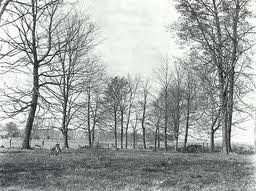
When the leaves go whirling fast.
November was the ninth month of the Roman calendar. Its name is derived from the Latin novem, nine. The Anglo Saxons called it Blotmonath (‘Bloodmonth’) or Windmonath (‘Wind Month’).
In Welsh it is Tachwedd – the month of slaughtering, or Y Mis Du – the black month. In Gaelic it is Ant-Samhuinn – the month of the Samhain festival.
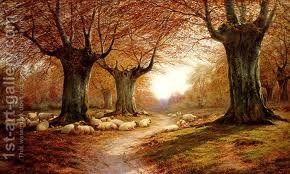
November is the pioneer of Winter, who comes, with his sharp winds and keen frosts, to cut down every bladed and leafy bit of green that is standing up, so as to make more room for the coming snowflakes to fall on the level waste, and form a great bed for Winter to sleep on . . . But amid all these images of desolation, which strike the eye more vividly through missing the richly-coloured foliage that threw such beauty over the two preceding months, November has still its berries which the early frosts have ripened to perfection.
November Sayings
November – the time when fishermen beached their boats and stopped fishing for winter.
No warmth, no cheerfulness, no healthful ease,
No comfortable feel in any member –
No shade, no shine, no butterflies, no bees,
No fruits, no flowers, no leaves, no birds – November!
Thomas Hood ‘No’ (1844)
On the first November if the weather hold clear
An end of what sowing you do for this year
November’s child is born to bless,
He’s like a song of thankfulness.
Married in veils of November mist,
Fortune your wedding ring has kissed.
If you wed in bleak November
Only joy will come, remember.
Ice in November to bear a duck,
Nothing afterwards but slush and muck.
November take flail,
Let ships no more sail.
Ice in November
Brings mud in December.
If the November goosebone be thick, so will the winter’s weather be.
If the November goosebone be thin, so will the winter’s weather be.
November’s sky in chill and drear,
November’s leaf is red and sear.
A child born at Hallowtide is sure to have the second sight and all November’s children will be fortunate and beloved.
A cold November, a warm Christmas.
Days of the Month
1st – All Saints Day and All Hallows Day
“For all thy saints
Who from their labours rest,
Who thee by faith
Before the world confessed . . .”
All Saints Day Hymn, Bishop W. Walsham Howe.
All Saints brings the second summer.
All Saints summer lasts three hours, three days or three weeks.
‘Hallow’ is an old word for ‘saint’. All Saints or All Hallows is a celebration of all the redeemed, both the known and the unknown, just in case some saints had slipped through the net of the year unnoticed.
On this day people remembered their departed relatives and prayed for them. Food is left out tonight in case the souls of the departed visit.
All Hallows summer starts today, a traditional spell of unseasonable warmth.
If ducks do slide at Hollantide, at Christmas they will swim;
If ducks do swim at Hollantide, at Christmas they will slide.
Up to the late nineteenth century this was Bonfire day (now 5th November – Bonfire Night).
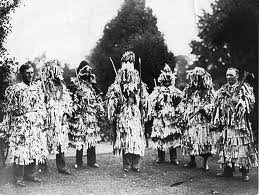
Mummers’ plays were performed to mark the beginning of winter, as a rite to revive the life-bearing sun.
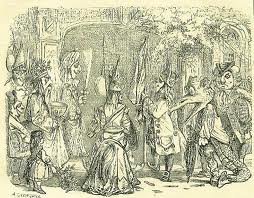
Samhain – a pagan festival marking the transition between summer and winter.
2nd – All Souls Day
It is a day on which prayers are said and masses celebrated for all those who have ever lived and died.
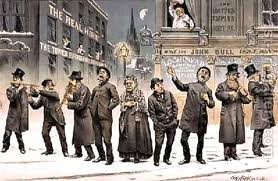
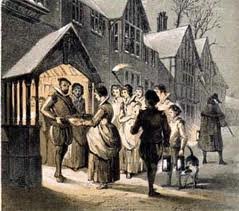
On this day soul cakes were made. People went from door to door singing a song in return for alms.
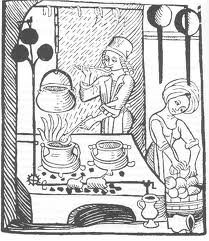
Souling songs were sung and it was customary to give soul cakes to all who called. These were small cakes flavoured with spices and brought luck.
Soul! Soul! for a soul cake!
I pray, good missus, a soul cake!
An apple or pear, a plum or cherry,
Any good thing to make us merry.
Traditional souling song
You gentlemen of England, I’d have you to draw near,
For we have come a-Souling for your strong ale and beer.
A soul-cake, a soul-cake,
Have mercy, Lord, on all Christian souls.
‘I hope you will prove kind with your apples and strong beer,
And we’ll come no more a-souling until this time next year.
One for Peter, one for Paul,
One for Him as made us all.
Up with your kettles, and down with your pans,
Give us a sou’cake and we will be gone.
Old souling song
3rd – St Winefrides Day
St Winefride’s Well in Holywell is the finest example of a medieval well. James II and his Queen visited in 1686 desperate for an heir, and it soon worked its magic.
Hundreds of people were said to have been cured of diseases after a dip in the special bathing pool. The water was also used for making wishes.
4th – St Cleer’s Day
He was a 6th century hermit. St Cleer, near Liskeard in Cornwall, is named after him, and his Holy Well still stands in the village.
A stick and a stake
For King George’s sake
Will you please to give us a faggot.
If you won’t give one, we’ll steal two,
The better for we and the worse for you.
Bonfire wood collecting Warwickshire rhyme
5th – Guy Fawkes/Bonfire Night
On this day in 1605 Guy Fawkes was arrested following the attempt to blow up Parliament.
November 5th was officially declared a day of national celebration. It became combined with the fire festivals already prevalent at this time of year and survives to the present day as Bonfire Night.
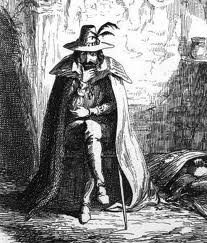
There are records of effigies being burnt on bonfires as early as the 1670s, although until the nineteenth century these were more likely to be of the Pope.
In the sixteenth century Mary I burnt 17 Protestant martyrs at Lewes in Sussex, an inflammatory act which continues to ignite the town in annual protest. Each November 5th they ‘burn the Pope’ and have a massive bonfire. People chant
‘A rope, a rope to hang the Pope, a piece of cheese to toast him,
A barrel of beer to drink his health, and a right good fire to roast him.’
There is a huge fancy dress torchlight parade through the streets.
‘We come a cob-a coalin; cob-a coalin,
We come a cob-a coalin for Bonfire Night.’
Citizens of York are not supposed to burn Guy today. He was a York-born soldier roped into the 1605 plot as a mercenary. He was ironically born a Protestant.
In addition to the well-known ‘Remember, remember the 5th of November, Gunpowder, treason and plot’, apposite rhymes today include:
Rumour, rumour, pump a derry,
Prick his heart and burn his body,
And send his soul to Purgatory.
and
Gunpowder Plot shall ne’er be forgot
As long as Bella Brown makes good Tom Trot.
Tom Trot was parkin, an oaty ginger and treacle cake.
The penny for the guy custom and the making of the guy for the garden bonfire are two widespread homely traditions that have largely disappeared and numerous others have come and gone.
Some families had special food for the evening. Jacket potatoes cooked on the edge of the bonfire, toffee apples, Bonfire toffee and gingerbread and parkin to munch on as the rockets were set off.
On the first Friday in November the Bridgewater carnival takes place and holds what is claimed to be the largest illuminated carnival in the world. Crowds of 150,000 pack the town. Around 150 floats take part, decorated with thousands of light bulbs. A huge firework display ends the evening. Blazing tar barrels, firecrackers and street bonfires used to be held.
“Men, boys and urchins paraded the streets decked out in their colourful costumes. Amongst the usual mix of characters was one young man who had the impudence to mimic ‘to an alarming extent’ the latest ladies fashion – crinoline. But the young ladies of the day were able to get their own back by throwing lighted firecrackers at this display from the safety of their upstairs windows.”
Local newspaper report of 1860.
6th – St Leonard’s Day
Died c.560. Patron saint of blacksmiths, coopers, greengrocers, prisoners of war, slaves and women in labour.
St Leonard is still remembered in the place names in Bucks, Dorset, St Leonard’s Forest, and in St Leonard’s, near Hastings.
7th – St Willibrord’s Day
10th – Martinmas Eve
Was seen as a time of feasting and merrymaking based on the habit of slaughtering animals at this time for salting down to last through the winter. It was a time of indoor gathering, where tales were told and games played, in defiance of the darkening nights and deteriorating weather of the autumn season:
Now that the year grows wearisome with age
And days grow short and nights excessively long
No outdoor sports the village hinds engage
Still is the meadow romp and harvest song.
John Clare – Martinmas Eve 1830
Martinmas Eve is Halloween Old Style and thus a second chance to look into the future.
Take three dishes, fill one with clean water, one with dirty water and leave one empty. A person is then blindfolded and led in to feel for a dish with their left hand; if they put their hand into the clean water, their future wife (or husband) will be a maid or bachelor; if into the dirty water they will wed a widow or widower, but if into the empty dish they will never marry.
11th – Martinmas
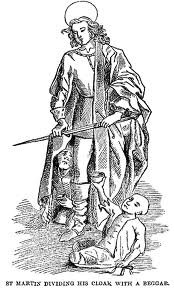
St Martin of Tours is the patron saint of soldiers. He was a 4th century saint. He served in the army before his baptism in AD 354, which allegedly followed a miraculous vision of Christ he experienced after sharing his military cloak with a freezing beggar. He became Bishop of Tours. After he died the cloak became a sacred relic, carried into battle as a banner by various French monarchs, and stored at other times in a sanctuary known as the chopelle or capella (from the old French chape, or Latin capella, cloak) from which the English word ‘chapel’ is derived.
If Martinmas ice will bear a duck,
Then look for a winter of slush and muck.
Weather wise, if it is very cold today, the winter will be gentle. Martinmas is usually quite mild, the start of a short spell known as St Martin’s summer, or the November Halcyon Days. This is because Martin gave his cloak to a beggar, and God commemorates this charity every year with a burst of unseasonably warm weather.
It is the day of Martinmas,
Cups of ale should freely pass,
What through winter has begun
To push down the summer sun.
To our fire we can be take
And enjoy the crackling brake,
Never heeding winter’s face
On the day of Martinmas.
Martinmas beef doth bear good tack
When country folk do daintier lack.
11th
In 1918 at the eleventh hour of the eleventh day of the eleventh month, the hostilities of World War I officially came to an end.
They shall grow not old, as we that are left grow old.
Age shall not weary them, nor the years condemn.
At the going down of the sun, and in the morning,
We will remember them.
Laurence Binyon, ‘For the Fallen’ (1914)
Armistice Day is also called Poppy Day, from the custom of wearing paper replicas of this flower. They grew in the battlefields of Flanders, their bright red symbolic of the blood that had been shed there.
In Flanders fields the poppies blow
Between the crosses, row on row
That mark our place; and in the sky
The Larks still bravely singing, fly
Scarce heard amid the guns below.
John McCrae, ‘In Flanders Fields’ (1915)
13th – St Brice’s Day
Brice was Bishop of Tours. He died in AD 444. He was soon accredited with saintly virtues and his cult was popular in England. The only English church dedicated to him is at Brize Norton, Oxfordshire.
The most well-known custom that took place on St Brice’s Day was the annual bull-running at Stamford. Every year on this day at 11 in the morning the church bells were rung to warn people off the streets, and a bull was released. After being chased through the town by people with their dogs yelling and shouting, it was pushed into the river. After it had managed to swim ashore in nearby meadows, the poor beast was finally killed and later eaten.
The last bull-running took place in 1839.
14th – St Dyfrig’s Day
He lived in the 6th century, and was said to have been the bishop who crowned Arthur.
On this day in 1635 died Old Parr of Shropshire, who claimed to have been born in 1483 and thus to be 152 years old. He married for the first time at 80, and for the second at 120; but the excitement of a visit to Charles I’s court proved fatal to him. He is buried in Westminster Abbey.
16th – St Margaret of Scotland’s Day
Margaret, who died in 1093, was one of the last of the Anglo-Saxon monarchs, wife of King Malcolm III.
A healing well at Liberton, in Edinburgh, is named after her.
17th – Queen Elizabeth’s Holiday
The anniversary of her accession to the throne in 1558, formerly much celebrated with bonfires and bell ringing.
‘Next came the Queen, in the sixty-sixth year of her age, as we were told, but very majestic. Her face was oblong, fair but wrinkled; her eyes small, but black and pleasant; her nose a little hooked, her lips narrow and her teeth black. She wore false hair and that was red.’
Paul Hentzner – Travels in England, 1598.
17th – St Hilda’s Day (614-680)
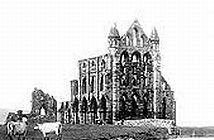
She founded the Abbey in Whitby, North Yorkshire. It became famous as a school. Five pupils of hers became bishops. Fifteen churches are dedicated to her.
17th – St Hugh of Avalon, also known as Hugh of Lincoln (Great Hugh) (1135-1200)
Hugh was a wise and fearless Bishop of Lincoln whose pet swan met him each time he returned to his palace. He has one church dedicated to him.
18th
The traditional time for making Christmas puddings is Stir Up Sunday, the Sunday before Advent Sunday, which is the final one in November. Each member of the family should stir the pudding and make a wish. The name Stir Up Sunday comes from the collect traditionally read on this day in church.
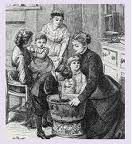
‘Stir up we beseech thee, O Lord, the wills of thy faithful people.’
A children’s rhyme chanted when alms collecting echoes this:
Stir up, we beseech thee, the pudding in the pot.
And when we get home we’ll eat the lot.
Puddings should be made of 13 ingredients, one for each Apostle and one for Jesus. They should be stirred with a wooden spoon – to recall the manger – and in a sunwise direction, retracing the route of the magi. It is still customary in some households to make 13 puddings, the last one is known as the Judas Pudding and is either given to a beggar or thrown out.
19th – St Ermenburga’s Day
A Kentish princess, who founded a nunnery at Minster on the Isle of Thanet.
20th – St Edmund’s Day (841-870), Patron Saint of Sailors
He was King of East Anglia, and murdered by the Vikings in 869 when he refused to champion their pagan cause by being tied to a tree and fired at with arrows and then beheaded. His head was hidden under a thorn bush, but when his followers sought it, the head itself was heard crying, ‘Here, here,’ and was discovered in the care of a monstrous white wolf.
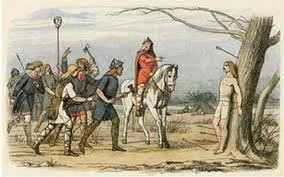
He was buried at the Suffolk town which then became Bury St Edmunds. St Edmund remains popular across East Anglia and schoolchildren on this day are given a specially baked St Edmunds bun.
Set garlic and beans at Edmund the King,
The moon in the wane thereof hangeth a thing.
21st – Old Michaelmas Eve
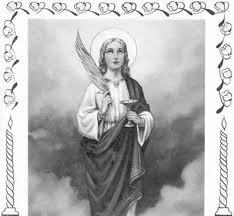
22nd – St Cecilia’s Day
She was a 3rd century Roman Christian, and is the patron saint of musicians. She was said to have invented the organ. Cecilia was condemned for her Christianity and put to death. St Cecilia’s Church in Rome is built on the site of the bath in which she died.
So when the last and dreadful hour
This crumbling pageant shall devour
The trumpet shall be heard on high
The dead shall live, the living die.
And musick shall untune the sky.
22nd
Today used to be a hatters’ holiday, being the eve of their patron saint, Clement. He was born saint and inventor. After a long and tiring walk, he found some wool and put this between his foot and the sandal, the combination of sweat and compaction resulted in the first felt.
22nd – Pack-Rag Day, called because servants now carried their possessions to new work places after finding new employment at the many hiring fairs held on this day – Martinmas Old Style.
Servant men, stand up for your wages
When to the hirings you do go,
For you must work all sorts of weather,
Both cold and wet and snow.
Old Shropshire Ballard
23rd
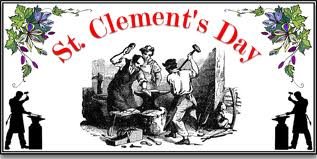
St Clement was a 4th century Christian martyr, drowned by being tied to an anchor. He is patron saint of blacksmiths and lighthouse men and hatters.
St Clement brings the winter.
Clementing, clementing once a year,
Apples and pears are very good cheer.
One for Peter, two for Paul,
And three for Him who made us all.
Up with the hatchet and down with the shoe,
If you have no apples, money will do.
Money will do, money will do.
In former times St Clements Day was celebrated with a custom known as clementing, which involved begging for money, fruit or cakes in exchange for a song. In some parts of the UK blacksmiths celebrated their patron saint’s feast day with parades through the streets with an effigy of St Clement called Old Clem and ended with a special meal called a Clem Supper.
Later children took up cleming and sang songs in return for apples or spiced Clements cakes.
At Walsall the mayor used to throw apples and pennies at the children in the name of Clement, while at Rippon, choristers handed out apples stuck through with a sprig of box.
25th – St Catherine’s Day
Patron saint of philosophers, librarians, unmarried women, wheelwrights, millers and lace makers. 80 churches are dedicated to her. She is said to have been tortured on a wheel in AD 310, hence the Catherine wheel firework and the Catherine or Rose window.
Her well is at Abbotsbury, near Weymouth. Put one knee and your hands in three holes inside the chapel, and wish aloud for a tall, dark stranger to engulf you.
The festival of St Catherine was often held together with St Clement.
‘Cattern and Clemen be here, be here,
Some of your apples and some of your beer.’
People went catterning, and cattern cakes and pies were made and eaten. The cakes were light and airy, made from sweet dough, flavoured with caraway. The pies were shaped like a Catherine wheel, filled with mince, honey and breadcrumbs.
Rise, maidens, rise,
Bake your cattern pies.
Bake enough and bake no waste,
And let the bellmen have a taste.
People played games. A favourite one was leaping over a lit candle. If it went out as you leaped, farewell good luck.
Kit be nimble, Kit be quick.
Kit jumps over the candlestick.
St Catherine was also involved in matters of matrimony. At St Catherine’s chapel in Abbotsbury, Dorset, women used to go and say the following prayer:
A husband, St Catherine,
A handsome one, St Catherine;
A rich one, St Catherine;
A nice one, St Catherine;
And soon, St Catherine!
The Cattern Bowl
A special drink was made out of cider, cinnamon and sugar, pulped apples were then added and it was given out to friends and family.
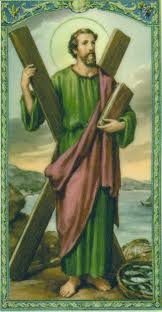
30th – St Andrew’s Day. Patron Saint of Scotland
When St Andrew was martyred in the 1st century AD, he opted for a X shaped (saltire) cross, as he felt unworthy of being killed in the same way as Jesus.
About 600 churches are dedicated to him.
St Andrew the King, three weeks and three days before Christmas come in.
‘Traditional saying’
On St Andrew’s Day the night is twice as long as day.
All over the world Scots raise the following toast today –
‘To the memory of St Andrew and Scotland yet.’
This was mischief night in Northamptonshire. Squirrel hunting was an annual event.
Elderberry wine and Tandra cake or St Andrew’s cake are eaten in England in areas of lace making such as Bedfordshire, Buckinghamshire, Hertfordshire and Northamptonshire. The holiday was known as ‘Tander’.
30th – Advent
Advent means ‘coming’, of the messiah. Christians celebrate the coming of Christ during Advent – the four weeks before Christmas. Advent Sunday is the nearest Sunday to 30th November.
Some people have an Advent wreath with four candles, one to light on each Sunday.
In the north of England before the Reformation poor women made two dolls called the Advent Images (representing the Virgin and Christchild) and went around the neighbourhood singing the ancient carol, ‘The first joy that Mary had, it was the joy of one’ and people contributed a coin.
Beechwood fires burn bright and clear
If the logs be kept a year.
Oaken logs if dry and old
Keep away the winter’s cold.
Chestnut’s only good, they say,
If for years ’tis laid away.
But ash-wood green or ash-wood brown
Are fit for a king with a golden crown.
Elm, she burns like the churchyard moule,
Even the very flames are cold.
Birch and pine-wood burn too fast,
Blaze too bright and do not last.
But ash wet or ash dry,
A Queen may warm her slippers by.
Sea Fever
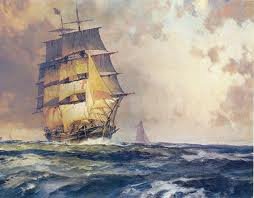
I must go down to the seas again, to the lonely sea and the sky,
And all I ask is a tall ship and a star to steer her by,
And the wheel’s kick and the wind’s song and the white sail’s shaking,
And a grey mist on the sea’s face and a grey dawn breaking.
I must go down to the seas again, for the call of the running tide
Is a wild call and a clear call that may not be denied;
And all I ask is a windy day with the white clouds flying,
And the flung spray and the blown spume, and the sea-gulls crying.
I must go down to the seas again, to the vagrant gypsy life,
To the gull’s way and the whale’s way where the wind’s like a whetted knife;
And all I ask is a merry yarn from a laughing fellow-rover,
And quiet sleep and a sweet dream when the long track’s over.
John Masefield