Last time I wrote about how the BBC helped create a fiction about how our early ancestors were not only Anglo Saxon, but were black or half-black as well – people who had never invented a sail but had somehow travelled here from Africa.
Fortunately that lie was eventually exposed by a product of modern science – DNA testing.
The multi-racial 1950s Cotswolds
That particular example of a big BBC lie was put out by a ‘documentary’ programme. But fiction has also been used and is still being used to try and convince us that non-whites have lived in Britain for at least hundreds of years.
Any series of programmes set in the past is liable to be misused in this way. One such that I have come across recently is Father Brown, based on a series of books of that name written by G.K. Chesterton (cousin of the late A.K.Chesterton, one of the founders of the National Front in 1967).
In it, Father Brown is a kindly, middle-aged Roman Catholic priest at Saint Mary’s Church in the fictional village of Kembleford, in the English Cotswolds. He is also an amateur sleuth who successfully investigates the alarmingly large number of murders that regularly occur in the parish.
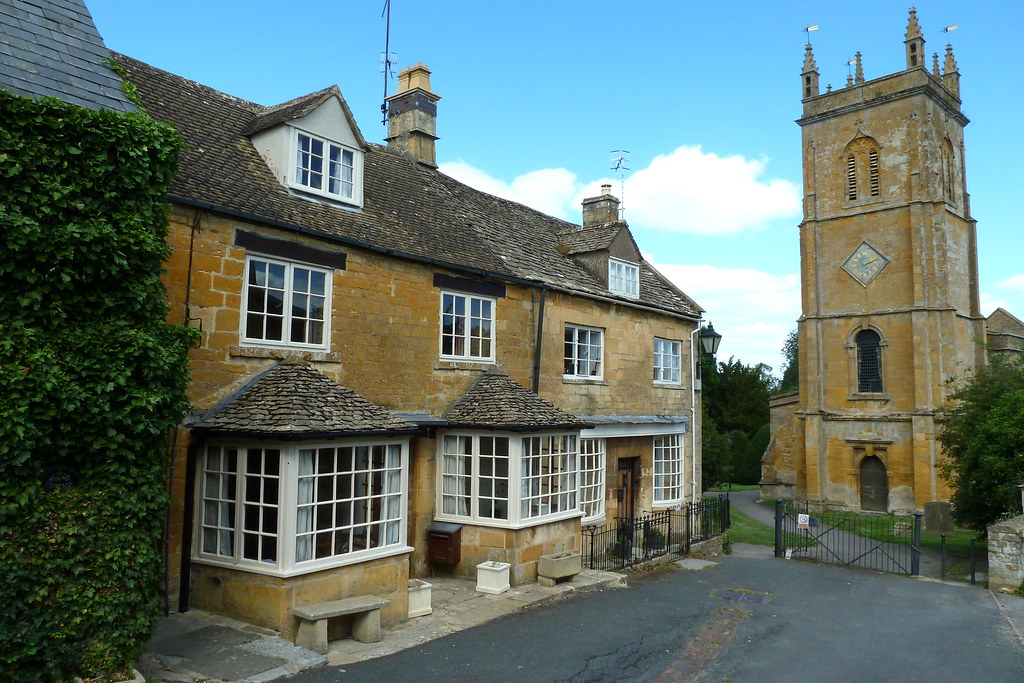
The English Cotswolds, as most of us know, is a spectacularly beautiful part of the country, largely in the South West, overwhelmingly countrified and consisting for the most part of villages separated by large areas of farmland.
The villages themselves have invariably grown organically over hundreds of years and consist typically of a twelfth century or earlier church, a couple of pubs, and a string of little cafes and shops that sell trinkets and souvenirs of the area to visitors. The houses and shops are mostly built from local stone with a unique, golden colouring, sometimes have thatched roofs, are at least a hundred years old, and are typically English in design and layout.
Sadly, in the twenty first century, it’s beauty and other-worldiness are indirectly the very things that threaten to destroy it. But the Father Brown TV series, like the books, is set in the 1950s.
Lies versus reality
I was born in 1948, the same year that the import of non-Whites into the British Isles began in earnest, with the arrival of the Windrush and its passengers in May of that year. As we know, before that event there were, at most, a tiny number of individuals resident in our country who were not White.
Growing up in the 1950s and 1960s in an area hardly ten miles from the centre of London, it was only in the mid 1960s that I, as a child of around 15 years of age, came to realise that black people had started to appear on the scene and actually intended to live here permanently.
I lived near a large town (Bromley, where I was born) and on most days travelled by bus through that town. It was at that time that I noticed a growing number of bus conductors on the buses were black. These were the first black people that I ever came across and I remember thinking them rather odd, but it was several years before I seriously considered the implications.
Contrast my experience, living in a place far more cosmopolitan than the rural, remote Cotswolds, with what the BBC presents as normal life some ten years before that time in Kembleford. This was just six or seven years after the steady stream of non-Whites moving into Britain commenced, when it was just a trickle compared to modern times.
The La-La land of the BBC
In the BBC’s fictional Kembleford, presented as typical of the Cotswolds of the mid-1950s, there are blacks and Asians in all walks of life, and it is accepted by all the White characters that their presence is perfectly unexceptional.
Indeed, one of the main characters is half-black. Although by any standards not a particularly good actress, she has kept her role throughout a number of series, and in that time her fictional character has become an adept chef, an expert flower arranger, discovered vital clues in assisting Father Brown in his role as a sleuth solving the weekly murders committed in that parish, and become the “pride of Kembleford” in representing the Cotswolds in a national televised dancing competition.
Other minority ethnic characters have been a black baker(!) with a well-established outlet in the village, a black farmer who ploughs his own fields, a long-standing (no pun intended) black bell-ringer at the church, and an Indian Master of Ceremonies at a traditional inter-village competition going back hundreds of years and featuring games like Stoolball, Shinty, and wrestling.
The BBC’s false narrative
The implication is that such people were well established in the Britain of the 1950s and therefore must have arrived several generations before that period. Impressionable young people who know little about the real history of the post-war period will gain from this series a false picture of community and local life at that time.
In other drama productions, the BBC would have us believe that Isaac Newton (who appeared in Doctor Who) and that the fictional Estella in Charles Dickens’s Great Expectations were of mixed race. Agatha Christie’s 1939 novel, Murder is Easy was adapted by the BBC with David Jonsson, who won the Black British Theatre Award in 2021, playing the lead. How many blacks were there in Britain in 1939 outside the docks areas of East London, Cardiff and Liverpool?
All this emphasis from the BBC on historic diversity drew considerable criticism from film and TV critics. At least not everyone in the media is brain-dead. As a result the BBC did one of the things it is good at – it commisssioned a report. This was published in early February 2026 and prepared by former BAFTA chairman Anne Morrison and Chris Banatvala, an independent consultant, formerly an executive at media regulator Ofcom (groan!). It must have been like the foxes reviewing security at the chicken coop.
‘Shoehorning’ diversity
Their main focus was not on the sheer absurdity of having non-White actors play the parts of both historic and fictional characters who were obviously White. It wasn’t even on the sinister practice of subtly suggesting to younger audiences that our population was “diverse” in earlier times when it was in fact homogenous. Instead, it was on how “shoehorning” diversity into dramas wasn’t being done skillfully enough, seeing as most viewers of these programmes want at least a modicum of authenticity.
So now BBC bosses have pledged to change diversity measures so as to include socio-economic backgrounds and geography as factors that should be considered in making “authentic” programmes. Oh, and to move more decision-making outside London.
Will all that make a lot of difference? As one BBC insider has reportedly said: “I’m not holding my breath.”


The Father Brown stories were set in an (admittedly fantastical) England of no later than the 1930s – GK Chesterton died in 1936.
Reading the article reminded me of another BBC tv series, also set in the 1950s, or part of it. Magpie Murders, is based on the book by Anthony Horowitz and is a story withing a story with a murder mystery set in the real world and a fictional one. Alan Conway is a best selling murder mystery author, and a loathsome individual. He puts anybody he doesn’t like(pretty much everybody), in his books, and not in a nice way. His sister in real life, becomes the frumpy, stupid, jobless individual, Detective Inspector Locke, becomes Detective Inspector Chubb and his homosexual lover(this is the BBC), becomes the dim sidekick of the fictional detective in the book.
Unlike the book, there are of course several black characters, a black girlfriend of a character who turns out to be a murderer, a black antiques dealer and his wife, an Indian doctor, and a black vicar. The vicar is included, presumably because he is the black vicar in real world.
One of the settings(indeed, the village where Conway lives), is the picturesque Suffolk village of Kersey. The village is described as the prettiest village in Suffolk, with its main street of medieval, timber framed, pink, orange, and pastel coloured houses that date from the 12th and 15th centuries. It has a pub, a school, and a village hall, and that is pretty much it, a review says that it is tiny, with a population of 350, and adds that, “there isn’t much to do”. You can only imagine what the population of the village must have been in 1950.
One of the most ridiculous scenes in the fictional world, is when the black vicar is walking down the main street, past the pub. Two old regulars ask him if he would like to join them for a drink. The notion of a black vicar walking down the street as if he and other black residents have been there for years is utterly absurd. These five or six black characters aren’t enough for the BBC and, in one scene(a funeral), there are five or six black extras(non speaking parts), giving the impression that black people have been part of village life for years. Considering that the Empire Windrush docked in 1948, it is amazing how so many black people were able to spread out to remote rural villages, especially ones where the house prices would have been prohibitive.