November

Dull November brings the blast
When the leaves go whirling fast.

November was the ninth month of the Roman calendar. Its name is derived from the Latin novem, nine. The Anglo Saxons called it Blotmonath (‘Bloodmonth’) or Windmonath (‘Wind Month’).

In Welsh it is Tachwedd – the month of slaughtering, or Y Mis Du – the black month. In Gaelic it is Ant-Samhuinn – the month of the Samhain festival.

November is the pioneer of Winter, who comes, with his sharp winds and keen frosts, to cut down every bladed and leafy bit of green that is standing up, so as to make more room for the coming snowflakes to fall on the level waste, and form a great bed for Winter to sleep on . . . But amid all these images of desolation, which strike the eye more vividly through missing the richly-coloured foliage that threw such beauty over the two preceding months, November has still its berries which the early frosts have ripened to perfection.

November Sayings

November – the time when fishermen beached their boats and stopped fishing for winter.

No warmth, no cheerfulness, no healthful ease,

No comfortable feel in any member –

No shade, no shine, no butterflies, no bees,

No fruits, no flowers, no leaves, no birds – November!

Thomas Hood ‘No’ (1844)

On the first November if the weather hold clear

An end of what sowing you do for this year

November’s child is born to bless,

He’s like a song of thankfulness.

Married in veils of November mist,

Fortune your wedding ring has kissed.

If you wed in bleak November

Only joy will come, remember.

Ice in November to bear a duck,

Nothing afterwards but slush and muck.

November take flail,

Let ships no more sail.

Ice in November

Brings mud in December.

If the November goosebone be thick, so will the winter’s weather be.

If the November goosebone be thin, so will the winter’s weather be.

November’s sky in chill and drear,

November’s leaf is red and sear.

A child born at Hallowtide is sure to have the second sight and all November’s children will be fortunate and beloved.

A cold November, a warm Christmas.

Days of the Month

1st – All Saints Day and All Hallows Day

“For all thy saints

Who from their labours rest,

Who thee by faith

Before the world confessed . . .”

All Saints Day Hymn, Bishop W. Walsham Howe.

All Saints brings the second summer.

All Saints summer lasts three hours, three days or three weeks.

‘Hallow’ is an old word for ‘saint’. All Saints or All Hallows is a celebration of all the redeemed, both the known and the unknown, just in case some saints had slipped through the net of the year unnoticed.

On this day people remembered their departed relatives and prayed for them. Food is left out tonight in case the souls of the departed visit.

All Hallows summer starts today, a traditional spell of unseasonable warmth.

If ducks do slide at Hollantide, at Christmas they will swim;

If ducks do swim at Hollantide, at Christmas they will slide.

Up to the late nineteenth century this was Bonfire day (now 5th November – Bonfire Night).

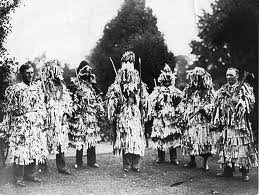
Mummers’ plays were performed to mark the beginning of winter, as a rite to revive the life-bearing sun.
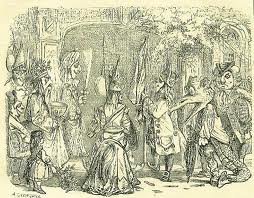
An early depiction of a mummers play

Samhain – a pagan festival marking the transition between summer and winter.

2nd – All Souls Day

It is a day on which prayers are said and masses celebrated for all those who have ever lived and died.

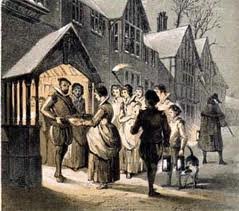
On this day soul cakes were made. People went from door to door singing a song in return for alms.
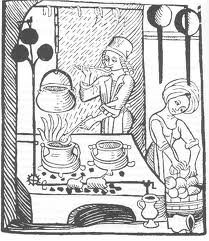
Soulcakes being prepared

Souling songs were sung and it was customary to give soul cakes to all who called. These were small cakes flavoured with spices and brought luck.

Soul! Soul! for a soul cake!

I pray, good missus, a soul cake!

An apple or pear, a plum or cherry,

Any good thing to make us merry.

Traditional souling song

You gentlemen of England, I’d have you to draw near,

For we have come a-Souling for your strong ale and beer.

A soul-cake, a soul-cake,

Have mercy, Lord, on all Christian souls.

‘I hope you will prove kind with your apples and strong beer,

And we’ll come no more a-souling until this time next year.

One for Peter, one for Paul,

One for Him as made us all.

Up with your kettles, and down with your pans,

Give us a sou’cake and we will be gone.

Old souling song

3rd – St Winefrides Day

St Winefride’s Well in Holywell is the finest example of a medieval well. James II and his Queen visited in 1686 desperate for an heir, and it soon worked its magic.

Hundreds of people were said to have been cured of diseases after a dip in the special bathing pool. The water was also used for making wishes.

4th – St Cleer’s Day

He was a 6th century hermit. St Cleer, near Liskeard in Cornwall, is named after him, and his Holy Well still stands in the village.

A stick and a stake

For King George’s sake

Will you please to give us a faggot.

If you won’t give one, we’ll steal two,

The better for we and the worse for you.

Bonfire wood collecting Warwickshire rhyme

5th – Guy Fawkes/Bonfire Night

On this day in 1605 Guy Fawkes was arrested following the attempt to blow up Parliament.

November 5th was officially declared a day of national celebration. It became combined with the fire festivals already prevalent at this time of year and survives to the present day as Bonfire Night.
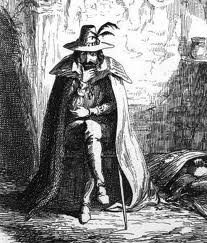
There are records of effigies being burnt on bonfires as early as the 1670s, although until the nineteenth century these were more likely to be of the Pope.

In the sixteenth century Mary I burnt 17 Protestant martyrs at Lewes in Sussex, an inflammatory act which continues to ignite the town in annual protest. Each November 5th they ‘burn the Pope’ and have a massive bonfire. People chant

‘A rope, a rope to hang the Pope, a piece of cheese to toast him,

A barrel of beer to drink his health, and a right good fire to roast him.’

There is a huge fancy dress torchlight parade through the streets.

‘We come a cob-a coalin; cob-a coalin,

We come a cob-a coalin for Bonfire Night.’

Citizens of York are not supposed to burn Guy today. He was a York-born soldier roped into the 1605 plot as a mercenary. He was ironically born a Protestant.

In addition to the well-known ‘Remember, remember the 5th of November, Gunpowder, treason and plot’, apposite rhymes today include:

Rumour, rumour, pump a derry,

Prick his heart and burn his body,

And send his soul to Purgatory.

and

Gunpowder Plot shall ne’er be forgot

As long as Bella Brown makes good Tom Trot.

Tom Trot was parkin, an oaty ginger and treacle cake.

The penny for the guy custom and the making of the guy for the garden bonfire are two widespread homely traditions that have largely disappeared and numerous others have come and gone.

Some families had special food for the evening. Jacket potatoes cooked on the edge of the bonfire, toffee apples, Bonfire toffee and gingerbread and parkin to munch on as the rockets were set off.

On the first Friday in November the Bridgewater carnival takes place and holds what is claimed to be the largest illuminated carnival in the world. Crowds of 150,000 pack the town. Around 150 floats take part, decorated with thousands of light bulbs. A huge firework display ends the evening. Blazing tar barrels, firecrackers and street bonfires used to be held.

“Men, boys and urchins paraded the streets decked out in their colourful costumes. Amongst the usual mix of characters was one young man who had the impudence to mimic ‘to an alarming extent’ the latest ladies fashion – crinoline. But the young ladies of the day were able to get their own back by throwing lighted firecrackers at this display from the safety of their upstairs windows.”

Local newspaper report of 1860.

6th – St Leonard’s Day

Died c.560. Patron saint of blacksmiths, coopers, greengrocers, prisoners of war, slaves and women in labour.

St Leonard is still remembered in the place names in Bucks, Dorset, St Leonard’s Forest, and in St Leonard’s, near Hastings.

7th – St Willibrord’s Day

10th – Martinmas Eve

Was seen as a time of feasting and merrymaking based on the habit of slaughtering animals at this time for salting down to last through the winter. It was a time of indoor gathering, where tales were told and games played, in defiance of the darkening nights and deteriorating weather of the autumn season:

Now that the year grows wearisome with age

And days grow short and nights excessively long

No outdoor sports the village hinds engage

Still is the meadow romp and harvest song.

John Clare – Martinmas Eve 1830

Martinmas Eve is Halloween Old Style and thus a second chance to look into the future.

Take three dishes, fill one with clean water, one with dirty water and leave one empty. A person is then blindfolded and led in to feel for a dish with their left hand; if they put their hand into the clean water, their future wife (or husband) will be a maid or bachelor; if into the dirty water they will wed a widow or widower, but if into the empty dish they will never marry.

11th – Martinmas
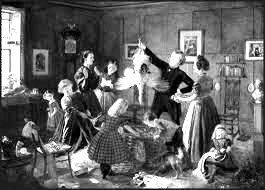
Early celebrations of Martinmass

St Martin of Tours is the patron saint of soldiers. He was a 4th century saint. He served in the army before his baptism in AD 354, which allegedly followed a miraculous vision of Christ he experienced after sharing his military cloak with a freezing beggar. He became Bishop of Tours. After he died the cloak became a sacred relic, carried into battle as a banner by various French monarchs, and stored at other times in a sanctuary known as the chopelle or capella (from the old French chape, or Latin capella, cloak) from which the English word ‘chapel’ is derived.
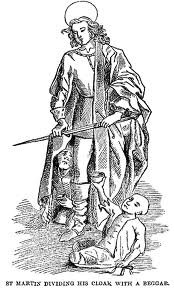
If Martinmas ice will bear a duck,

Then look for a winter of slush and muck.

Weather wise, if it is very cold today, the winter will be gentle. Martinmas is usually quite mild, the start of a short spell known as St Martin’s summer, or the November Halcyon Days. This is because Martin gave his cloak to a beggar, and God commemorates this charity every year with a burst of unseasonably warm weather.

It is the day of Martinmas,

Cups of ale should freely pass,

What through winter has begun

To push down the summer sun.

To our fire we can be take

And enjoy the crackling brake,

Never heeding winter’s face

On the day of Martinmas.

Martinmas beef doth bear good tack

When country folk do daintier lack.

11th

In 1918 at the eleventh hour of the eleventh day of the eleventh month, the hostilities of World War I officially came to an end.

They shall grow not old, as we that are left grow old.

Age shall not weary them, nor the years condemn.

At the going down of the sun, and in the morning,

We will remember them.

Laurence Binyon, ‘For the Fallen’ (1914)

Armistice Day is also called Poppy Day, from the custom of wearing paper replicas of this flower. They grew in the battlefields of Flanders, their bright red symbolic of the blood that had been shed there.

In Flanders fields the poppies blow

Between the crosses, row on row

That mark our place; and in the sky

The Larks still bravely singing, fly

Scarce heard amid the guns below.

John McCrae, ‘In Flanders Fields’ (1915)

13th – St Brice’s Day

Brice was Bishop of Tours. He died in AD 444. He was soon accredited with saintly virtues and his cult was popular in England. The only English church dedicated to him is at Brize Norton, Oxfordshire.

The most well-known custom that took place on St Brice’s Day was the annual bull-running at Stamford. Every year on this day at 11 in the morning the church bells were rung to warn people off the streets, and a bull was released. After being chased through the town by people with their dogs yelling and shouting, it was pushed into the river. After it had managed to swim ashore in nearby meadows, the poor beast was finally killed and later eaten.

The last bull-running took place in 1839.

14th – St Dyfrig’s Day

He lived in the 6th century, and was said to have been the bishop who crowned Arthur.

On this day in 1635 died Old Parr of Shropshire, who claimed to have been born in 1483 and thus to be 152 years old. He married for the first time at 80, and for the second at 120; but the excitement of a visit to Charles I’s court proved fatal to him. He is buried in Westminster Abbey.
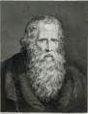
Old Parr

16th – St Margaret of Scotland’s Day

Margaret, who died in 1093, was one of the last of the Anglo-Saxon monarchs, wife of King Malcolm III.

A healing well at Liberton, in Edinburgh, is named after her.

17th – Queen Elizabeth’s Holiday

The anniversary of her accession to the throne in 1558, formerly much celebrated with bonfires and bell ringing.

‘Next came the Queen, in the sixty-sixth year of her age, as we were told, but very majestic. Her face was oblong, fair but wrinkled; her eyes small, but black and pleasant; her nose a little hooked, her lips narrow and her teeth black. She wore false hair and that was red.’

Paul Hentzner – Travels in England, 1598.

17th – St Hilda’s Day (614-680)

She founded the Abbey in Whitby, North Yorkshire. It became famous as a school. Five pupils of hers became bishops. Fifteen churches are dedicated to her.
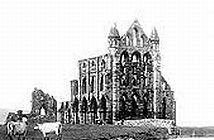
St. Hilda’s Abbey, Whitby

17th – St Hugh of Avalon, also known as Hugh of Lincoln (Great Hugh) (1135-1200)

Hugh was a wise and fearless Bishop of Lincoln whose pet swan met him each time he returned to his palace. He has one church dedicated to him.

18th

The traditional time for making Christmas puddings is Stir Up Sunday, the Sunday before Advent Sunday, which is the final one in November. Each member of the family should stir the pudding and make a wish. The name Stir Up Sunday comes from the collect traditionally read on this day in church.
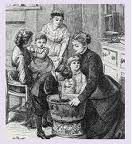
Celebrating Stirup Sunday

‘Stir up we beseech thee, O Lord, the wills of thy faithful people.’

A children’s rhyme chanted when alms collecting echoes this:

Stir up, we beseech thee, the pudding in the pot.

And when we get home we’ll eat the lot.

Puddings should be made of 13 ingredients, one for each Apostle and one for Jesus. They should be stirred with a wooden spoon – to recall the manger – and in a sunwise direction, retracing the route of the magi. It is still customary in some households to make 13 puddings, the last one is known as the Judas Pudding and is either given to a beggar or thrown out.

19th – St Ermenburga’s Day

A Kentish princess, who founded a nunnery at Minster on the Isle of Thanet.

20th – St Edmund’s Day (841-870), Patron Saint of Sailors

He was King of East Anglia, and murdered by the Vikings in 869 when he refused to champion their pagan cause by being tied to a tree and fired at with arrows and then beheaded. His head was hidden under a thorn bush, but when his followers sought it, the head itself was heard crying, ‘Here, here,’ and was discovered in the care of a monstrous white wolf.
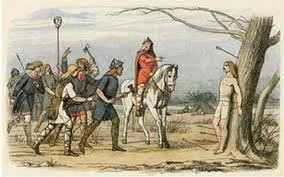
The murder of St. Edmund

He was buried at the Suffolk town which then became Bury St Edmunds. St Edmund remains popular across East Anglia and schoolchildren on this day are given a specially baked St Edmunds bun.

Set garlic and beans at Edmund the King,

The moon in the wane thereof hangeth a thing.

21st – Old Michaelmas Eve

22nd – St Cecilia’s Day

She was a 3rd century Roman Christian, and is the patron saint of musicians. She was said to have invented the organ. Cecilia was condemned for her Christianity and put to death. St Cecilia’s Church in Rome is built on the site of the bath in which she died.

So when the last and dreadful hour

This crumbling pageant shall devour

The trumpet shall be heard on high

The dead shall live, the living die.

And musick shall untune the sky.

22nd

Today used to be a hatters’ holiday, being the eve of their patron saint, Clement. He was born saint and inventor. After a long and tiring walk, he found some wool and put this between his foot and the sandal, the combination of sweat and compaction resulted in the first felt.
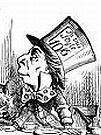
Lewis Carroll’s Mad Hatter

22nd – Pack-Rag Day, called because servants now carried their possessions to new work places after finding new employment at the many hiring fairs held on this day – Martinmas Old Style.

Servant men, stand up for your wages

When to the hirings you do go,

For you must work all sorts of weather,

Both cold and wet and snow.

Old Shropshire Ballard

23rd
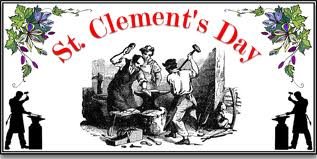
St Clement was a 4th century Christian martyr, drowned by being tied to an anchor. He is patron saint of blacksmiths and lighthouse men and hatters.

St Clement brings the winter.

Clementing, clementing once a year,

Apples and pears are very good cheer.

One for Peter, two for Paul,

And three for Him who made us all.

Up with the hatchet and down with the shoe,

If you have no apples, money will do.

Money will do, money will do.

In former times St Clements Day was celebrated with a custom known as clementing, which involved begging for money, fruit or cakes in exchange for a song. In some parts of the UK blacksmiths celebrated their patron saint’s feast day with parades through the streets with an effigy of St Clement called Old Clem and ended with a special meal called a Clem Supper.

Later children took up cleming and sang songs in return for apples or spiced Clements cakes.

At Walsall the mayor used to throw apples and pennies at the children in the name of Clement, while at Rippon, choristers handed out apples stuck through with a sprig of box.

25th – St Catherine’s Day

Patron saint of philosophers, librarians, unmarried women, wheelwrights, millers and lace makers. 80 churches are dedicated to her. She is said to have been tortured on a wheel in AD 310, hence the Catherine wheel firework and the Catherine or Rose window.

Her well is at Abbotsbury, near Weymouth. Put one knee and your hands in three holes inside the chapel, and wish aloud for a tall, dark stranger to engulf you.

The festival of St Catherine was often held together with St Clement.

‘Cattern and Clemen be here, be here,

Some of your apples and some of your beer.’

People went catterning, and cattern cakes and pies were made and eaten. The cakes were light and airy, made from sweet dough, flavoured with caraway. The pies were shaped like a Catherine wheel, filled with mince, honey and breadcrumbs.

Rise, maidens, rise,

Bake your cattern pies.

Bake enough and bake no waste,

And let the bellmen have a taste.

People played games. A favourite one was leaping over a lit candle. If it went out as you leaped, farewell good luck.

Kit be nimble, Kit be quick.

Kit jumps over the candlestick.

St Catherine was also involved in matters of matrimony. At St Catherine’s chapel in Abbotsbury, Dorset, women used to go and say the following prayer:

A husband, St Catherine,

A handsome one, St Catherine;

A rich one, St Catherine;

A nice one, St Catherine;

And soon, St Catherine!

The Cattern Bowl

A special drink was made out of cider, cinnamon and sugar, pulped apples were then added and it was given out to friends and family.

30th – St Andrew’s Day. Patron Saint of Scotland

When St Andrew was martyred in the 1st century AD, he opted for a X shaped (saltire) cross, as he felt unworthy of being killed in the same way as Jesus.

About 600 churches are dedicated to him.

St Andrew the King, three weeks and three days before Christmas come in.

‘Traditional saying’
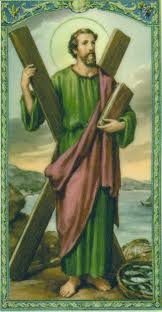
St. Andrew

On St Andrew’s Day the night is twice as long as day.

All over the world Scots raise the following toast today –

‘To the memory of St Andrew and Scotland yet.’

This was mischief night in Northamptonshire. Squirrel hunting was an annual event.

Elderberry wine and Tandra cake or St Andrew’s cake are eaten in England in areas of lace making such as Bedfordshire, Buckinghamshire, Hertfordshire and Northamptonshire. The holiday was known as ‘Tander’.

30th – Advent

Advent means ‘coming’, of the messiah. Christians celebrate the coming of Christ during Advent – the four weeks before Christmas. Advent Sunday is the nearest Sunday to 30th November.

Some people have an Advent wreath with four candles, one to light on each Sunday.

In the north of England before the Reformation poor women made two dolls called the Advent Images (representing the Virgin and Christchild) and went around the neighbourhood singing the ancient carol, ‘The first joy that Mary had, it was the joy of one’ and people contributed a coin.

Beechwood fires burn bright and clear

If the logs be kept a year.

Oaken logs if dry and old

Keep away the winter’s cold.

Chestnut’s only good, they say,

If for years ’tis laid away.

But ash-wood green or ash-wood brown

Are fit for a king with a golden crown.

Elm, she burns like the churchyard moule,

Even the very flames are cold.

Birch and pine-wood burn too fast,

Blaze too bright and do not last.

But ash wet or ash dry,

A Queen may warm her slippers by.

Sea Fever
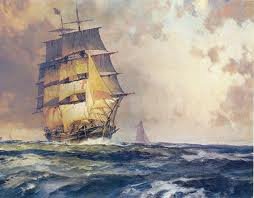
I must go down to the seas again, to the lonely sea and the sky,

And all I ask is a tall ship and a star to steer her by,

And the wheel’s kick and the wind’s song and the white sail’s shaking,

And a grey mist on the sea’s face and a grey dawn breaking.

I must go down to the seas again, for the call of the running tide

Is a wild call and a clear call that may not be denied;

And all I ask is a windy day with the white clouds flying,

And the flung spray and the blown spume, and the sea-gulls crying.

I must go down to the seas again, to the vagrant gypsy life,

To the gull’s way and the whale’s way where the wind’s like a whetted knife;

And all I ask is a merry yarn from a laughing fellow-rover,

And quiet sleep and a sweet dream when the long track’s over.

John Masefield
Looking backwards, looking forward

Will Wright

Coming together, coming apart

In 1967, a number of British Nationalist parties merged to form the National Front. I do not know if the term ‘nationalist unity’ was bandied about, but that was the unmistakable aim of the merger. Almost all British Nationalists belonged to the National Front.

By 1972, there was a short-lived splinter group, the National Independence Party. That was followed by the National Party, in 1975. That party was defunct two years later. But the name that the public knew was the National Front.

By 1980, things were much more serious. In the Midlands, there was a rebellion. The British Democratic Party was formed. Then Andrew Fountaine created the Constitutional Movement, which became the Nationalist Party. Then John Tyndall created the New National Front, which became the British National Party.

Since the NF’s founding, there was the tiny, and infiltrated, British Movement which was parasitic on the NF.

All of these groups damaged both the cause of nationalist unity and British Nationalism itself. Yet the odd thing is many of those splitters began talking of nationalist unity.

The National Front had split four ways. Yet further wreckers caused the rump of the NF to be split another three or four ways. The party effectively died in the 1980s.

Tyndall’s BNP limped on. Older members died. Few people were recruited. When Nick Griffin seized the leadership, the BNP began to expand. But few among the new recruits ever became proper ideological nationalists.

I had joined the NF in 1974, and I joined the BNP in the 1990s, because it appeared that British Nationalism might again be moving forward. But that party too split into numerous splinter groups.

But the important thing to realise is that most ordinary rank-and-file British Nationalists are not factional. If they see a once united party breaking up, then they simply drop out of politics altogether. That happened with both the NF and later the BNP.

Fake organisations

The Establishment had a hand in destroying both the NF and the BNP. The NF had been subjected to very serious violence since the beginning. It suffered infiltration, official harassment of various kinds, media vilification, oppressive laws, and much else.

The BNP also suffered some of those things. But it also suffered the organisation and leading individuals permanently ‘debanked’ long before Nigel Farage experienced that temporary nuisance. By then, finding printers was also a problem.

A political party that has no bank account and cannot print literature has an enormous handicap.

But the Establishment hit on a new idea also. UKIP had been founded by a Liberal, to oppose British membership of what became the European Union. A few desperate British Nationalists saw it as a substitute for a nationalist movement.

But the Establishment was wise to infiltration. UKIP constitutionally banned all former and current members of the NF and the BNP.

The State could have it both ways. The public could vote for a tame organisation that wasn’t ideologically nationalist but never officially declared that, while real nationalists were excluded.

As Farage moved from UKIP to the Brexit Party and then Reform UK, the ban on British Nationalists continued.

But Farage did not run street protests or marches. For that, the secret state needed the services of Stephen Yaxley-Lennon, known as ‘Tommy Robinson.’ Martin Webster warned his subscribers about ‘Robinson.’ So too did Nick Griffin, then still the head of the BNP.

But the secret state now had a controlled opposition. UKIP and its successors for elections and Tommy Robinson for the streets.

Problems

A lot of rank-and-file nationalists were, and are, lazy. They have not been active, and they have read very little. Partly, because of the latter, they cannot tell a genuine organisation from a fake one.

Our country is threatened on multiple fronts. Our sovereignty is threatened by international organisations. Our very existence is threatened, at home, by mass immigration and a multi-racial society. Separatist groups want to split the United Kingdom apart.

But uninformed patriots hear “Stop the Boats!” and assume that is a call to end multi-racialism. But very often it is not. Anyone who criticises Islam in the UK, is assumed to be against a multi-racial society. Very often those people are not opposed to a multi-racial society.

Anyone who waves a Union Jack is assumed to be one of us. Obviously, waving a Union Jack is far preferable to waving the red flag of the Left, or the EU flag, but it is not proof of ideological integrity.

The Tories have been betraying Britain ever since 1945 but still making patriotic noises and displaying the Union Jack at their conferences.

Under Blair, Labour adopted the Red Rose, instead of the Red Flag. Starmer had the Union Jack printed on Labour election leaflets – much to the horror and protests of a very large section of his rank-and-file.

But patriotic symbols, divorced from patriotic policies and patriotic action, are a shabby confidence trick.

Some people understand that idea, when looking at the two main parties of government. But for some reason, they cannot see that principle, if the flag bearer is Nigel Farage or Tommy Robinson, and now Danny Tommo.

We should believe in an all-White Britain. Nigel Farage will not even stop legal immigration. (He probably won’t stop illegal immigration either.) Farage will not implement phased repatriation of settled immigrants in any meaningful numbers.

UKIP was a White party. But Reform UK is deliberately a multi-racial party, with two built-in Jewish sections. Farage is happy to accept a multi-racial society.

Tommy Robinson, Danny Tommo, and John Francis all oppose British Nationalism.

With the indigenous population now probably at about seventy percent of the whole, an aging (and dying) White population, and legal immigration at an at time high, stopping the boats is not going to make much difference, even if it ever happens.

We need to stop ALL legal immigration, and we need remigration. Ideally, that would be repatriation. But if foreigners cannot return home, they can still leave Britain. But Farage, Robinson, Tommo, or John Francis do not support that. Only Farage is ever likely to be in a position to do that, anyway.

These people are not our friends or ideological bedfellows.

What is to be done?

Both Griffin and Collett believe that the electoral route to power, for British Nationalists, is blocked by Farage. Before long, it will be impossible for any racial nationalist party to win, even in theory, because of changing demographics.

If we accept that Farage does not even intend to stop legal immigration, then on that basis, it begins to look like Nick Griffin has a point when he says we will not see significant remigration in our lifetimes. (And that is assuming that Farage actually wins power.)

Griffin does not even advocate remigration, because he sees it as a waste of time and energy. Collett does still advocate remigration.

I think we should still say we favour that solution, even if we never see it happen.

Griffin thinks all British Nationalists should join Rupert Lowe’s Restore Britain. That party will not win power, but Griffin hopes that Nationalists could radicalise the big numbers inside that party, in readiness for a time when White areas will need to be made secure.

Meanwhile, Mark Collett wants Reform UK to win the next general election. Not from a stance of hero-worship of Farage, but as a strategy to destroy the Conservative Party, and possibly eventually, the Labour Party, too.

Reform will have much shallower roots than the two main parties.

I like both Griffin’s ‘entryist’ intentions towards Restore Britain AND Collett’s purely strategic support for a Reform UK election victory. But it immediately strikes me that these two ideas could be mutually exclusive.

And something else occurs to me. Sometimes revolutions take on a life of their own.

Revolution

Revolutions eat their own children. Robespierre went to the guillotine. Trotsky was assassinated. Ernst Rohm was assassinated. Those were violent times.

Farage is not well. He has had several (at least three) brushes with death. One day he will be replaced. Just perhaps, it could be by a younger, more radical man who does believe in remigration.

Of course, the Establishment is trying to ensure that Reform UK is absorbed. The inclusion of high-ranking non-Whites shows us that. So too, does the inclusion of two Jewish lobbying groups.

Elite Theorists argue that the ordinary people never change anything. But they are not forced to be completely right. Even dictators need to have popular support to rule for any length of time.

In spite of Establishment, non-White, and minority Jewish efforts, a large grassroots remigration movement might one day influence the direction of travel of Reform UK.

Both the Establishment and the people once supported British membership of the EU, but opinions change. Maybe the idea of remigration might become mainstream, in spite of Griffin’s thoughts on the matter.

Like Griffin, Collett, and all other sincere Nationalists, I am left clutching at straws.

We must continue to hope and pray and stay optimistic. Sometimes, when all looks lost something totally unexpected happens.

© Will Wright 2026. For permission to reproduce this post please contact the author through this web site.

December

December was the tenth month of the Roman Calendar. Its name is derived from the Latin decem, ten.

The Anglo-Saxons called it Wintemonath, in Gaelic it is An mios marbh – the dead month. In Welsh – Rhagfyr – the month of preparation, and Giuli – the month of Yule.

Chill December brings the sleet,
Blazing fires and Christmas treat.

Dark December has now come, and brought with him the shortest day and longest night; he turns the mist-like rain into ice with the breath of his nostrils; and with cold that pierces to the very bones, drives the shivering and houseless beggar to seek shelter in the deserted shed . . . Even the houses, with their frosted windows, have now a wintry look; and the iron knocker of the door, covered with hoary rime, seems to cut the fingers like a knife when it is touched.

Sayings

A windy Christmas Day, a good crop of fruit.

If the ice will bear a man before Christmas it will not bear a mouse afterwards.

Clear moon – frost soon.

December cold with snow, good for rye.

Married in days of December cheer,
Love’s star shines brighter from year to year.

A green Christmas means a fat churchyard.

If Christmas Day falls on a Sunday, the next summer will be a hot one. If it falls on a Thursday, the following year will have much wind – and a dry wind that will be.

If the sun shines on the branches on Christmas Day, the fruit trees will bear well.

If Christmas Day be bright and clear
There’ll be two winters in that year.

Hours of sun on Christmas Day,
So many frosts in the month of May.

Days of the Month

1st – Christians celebrate the start of Advent

On this day in 1797 the seven shilling piece was issued.

‘The swaggering blade who has spent all his money
First searches his pockets, then looks very funny,
But his horrid perplexities suddenly cease
Should there lurk in his fob a seven shilling piece.’

3rd – St Birinus Day

He became the first Bishop of Dorchester. In 650 he was bitten by an adder and died. Before expiring Birinus declared that all people of Dorchester would be forever protected from snake-bite as long as they stayed within earshot of the church bells. Ever since locals have been able to drink vast quantities of mixed cider and lager without fear of falling over!

4th – St Barbara’s Day. St Barbara is invoked by artillerymen and miners to ward off explosions.

This is said to be because St Barbara was saved from execution by her father when he was struck by a bolt of lightning just as he was about to chop off her head. St Barbara became associated with the power to control thunderstorms.

When a thick band of cloud blankets the western sky with smaller cloud bands above and below, this is referred to as Barbara and her barns (bairns, children).

St Osmund’s Day

St Osmund was Bishop of Salisbury. He died in 1099. St Osmund can be invoked for curing toothache, rupture, madness and paralysis.

5th – St Justinian’s Day. He was a Breton hermit. St Justinian’s Spring used to be on Ramsey Island, near St Davids.

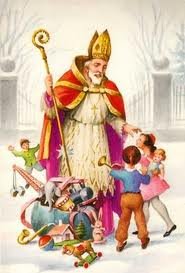
6th – St Nicholas’ Day. He was known for his kindness and generosity to children. He is patron saint of children, single women, pawn brokers, apothecaries, bankers, clerks, captives, perfumers, and sailors.

St Nicholas

He was Bishop of 4th century Myra in Turkey. He died on this day in AD 328.

According to one legend he gave away three bags of gold for the dowries of three poor sisters. This is remembered in the pawnbrokers’ sign of three gold balls.

By tradition he visits homes to see if children have been good, and if so leaves small gifts. He is accompanied by Black Peter, a mischievous imp, who carries a bundle of canes for use on naughty children.

After the Reformation the feast of St Nicholas was amalgamated with Christmas Day. Santa Claus is a corruption of the Dutch name for St Nicholas.

Cathedral towns used to elect a Boy Bishop on this day, who served until Holy Innocents Day (28th December). The Boy Bishop undertook all duties except taking Mass.

Three weeks before Christmas the curfew bells at Scarcliffe Church near Chesterfield in Derbyshire traditionally begin their nightly peal, which lasted until three weeks after the 25th.

11th

The beginning of the Halcyon Days of December, a spell of traditionally fine weather. Halcyon is another name for the Kingfisher. They were supposed to build their nests on the sea at this time of year, calming the waves with their song.

12th St Finnian’s Night

Anyone who goes to bed supperless on this night is likely to be carried over the housetop by the fairies.

13th – St Lucy’s Day

Patron saint of blind people, St Lucy was a devout virgin who gave all her worldly goods to the poor (thereby, in true Christian fashion, joining the ranks of the poor herself).

St Lucy

Lucy light, the shortest day and longest night.

Lucy can be invoked by people suffering from poor eyesight. She is regarded as the bringer of light.

14th – St Tibba’s Day

Tibba and her cousin Eabba, lived in Rutland in the seventh century. They were both devout hermits who became saints after their deaths.

St Tibba is the patron saint of falconers and wild fowlers. In Ryhall in Rutland there is a well named after her.

On this day in 1542 one of Scotland’s best loved monarchs, King James V, died.

16th – the official start of the mince pie season

December 16th is known as a sapientia, after the anthem traditionally sung today.

17th – Saturnalia

The seventeenth was the start of the seven day Roman festival, Saturnalia, in honour of the god of agriculture, ancestor of modern Christmas.

The 17th is known as Sow Day. Pigs were killed and eaten. No banquet was complete without the boar’s head until well into the 17th century. The orange or apple stuffed into its mouth is a piece of solar imagery.

In Nottinghamshire mince pigs made out of pastry (stuffed with mincemeat) and shaped like pigs with currants for eyes were made for the festive season.

Pigs are said to be able to see the wind.

20th – St Thomas’s Eve

Take an onion, peel it, stick pins in it, and retire to bed with the words –

Good St Thomas, do me right.
Send me my true love tonight.

21st – St Thomas’s Day. The Winter Solstice. When the hours of darkness are at their longest and daylight at their shortest.

On this day people went ‘Thomasing’ or gooding. Poor women tramped around their neighbourhood calling at farms and houses of their better off neighbours, expecting to receive doles of money or food in order to ‘keep a good Christmas’, singing as they went,

‘Please we’ve come a Thomasing, remember St Thomas’s Day.’

‘St Thomas Gray, St Thomas Gray,
The longest night and the shortest day.’

Today marks the end of autumn and the beginning of winter. In pagan times bonfires were lit to frighten away evil spirits, and other activities were held, some of which were absorbed into the festivities of Christmas and the New Year.

St Thomas Divine.
Brewing, baking and killing of fat swine.

Christmas is coming and the geese are getting fat
Please spare a penny for the old man’s hat.
If you haven’t a penny, a ha’penny will do.
If you haven’t got a ha’penny, God bless you.

Christmas Eve

T’was the night before Christmas, when all through the house
Not a creature was stirring, not even a mouse.
Clement Moore, The Night Before Christmas (1822)

Christmas Eve is a traditional time for Nativity Plays and for mummers’ plays. The latter often included the legend of St George and the Dragon. Other characters included The Grand Turk, The Gallant Knight, The Doctor, The Fool or Jester, and Old Father Christmas.

Underlying all mumming plays is the seasonal theme of the conflict between good and evil, darkness and light.

Mumming Songs

‘For one mug of your Christmas ale
Would make us all merry and sing;
And money in our pockets is
A very fine thing . . .’

In comes I, Old Father Christmas,
Am I welcome or am I not?
I hope Old Father Christmas
Will never be forgot.

Village lads they may have been, well known to everyone in their audience, but a shadow of the old fear and magic remained as they clattered in disguised, from the frosty lanes, and even in the nineteenth century it was felt unwise to name them.

If a girl walks backwards to a pear tree on Christmas Eve, and walks around the tree three times, she will see an image of her future husband.

For those who keep bees, failure to tell them of any important news such as marriage and death can result in substandard honey, the death of the bees or their desertion of the hive.

In some parts of the country keys were rattled at the hive and then the rhyme

‘Honey bees! Honey bees! Hear what I say!
Your master, X, has passed away.
But his wife now begs you weely stay,
And still gather honey for many a day.
Bonny bees, bonny bees, hear what I say.’

‘Twas said that on Christmas Eve at midnight all the cattle would kneel in their stalls.

Christmas Eve, and twelve of the clock,
‘Now they are all on their knees,’
An elder said as we sat in a flock
By the embers in hearthside ease.
Thomas Hardy

The most important event of Christmas Eve was the hauling in of the Yule log. Once inside, it was rolled on to the fire and had to be kept burning throughout Christmas until Twelfth Night.

‘Come bring with a noise
My merrie, merrie boyes,
The Christmas log to the firing;
While my good dame, she
Bids ye all be free;
And drink to your heart’s desiring.’
Robert Herrick

The arrival of the Yule log inside the house on Christmas Eve was always an opportunity for a celebration.

Bringing in the Yule log

They pile the Yule log on the hearth,
Soak toasted crabs in ale;
And while they sip, their homely mirth
Is joyous as if all the earth
For man were void of bale.
Thomas Cooper 1846

The Waits

An essential part of the run-up to Christmas was the evening visits by musicians, called the Waits. A number of medieval towns maintained bodies of Waits, York, Leicester and Norwich among them.

Their duties included providing music at public events, as night watchmen patrolling the streets at night and playing softly and announcing time, to reassure that all was well.

The Waits

Dumb Cake

It was customary on this night for single girls to make a dumb-cake, which had to be baked in complete silence. The name of the maker pricked her initials on the top of the cake. When baked, it was placed on the hearthstone. At midnight her future husband would walk in and prick his initials next to her. Then one would eat the cake.

Stockings are hung up at the end of children’s beds or by the chimney, and a glass of sherry and a mince pie left for Father Christmas and a carrot for Rudolph.

‘What will go in the Christmas stocking
While the clock on the mantelpiece is ticking?
An orange, a penny,
Some sweets, not too many,
A handful of love,
Another of fun,
And it’s very nearly done.’
Eleanor Farjean

Christmas Day

Christmas comes but once a year,
But when it comes it brings good cheer.
Traditional saying

Anyone born on Christmas Day is able to see spirits and immune to hanging or drowning.

A time for playing games

After lunch games were played. Most of these are long forgotten, and remembered in name only. Cross and Pyle, Hot Cockles Hot, The Parson Has Lost His Cloak, Feed The Dove, Hawld Hard, Turn Trencher, Round About Our Coal Fire, whilst others such as Hunt The Slipper, Puss In The Corner, and Blind Man’s Buff live on as children’s games.

A traditional Christmas game is Snapdragon. Raisins are put in a flat dish and set alight with brandy. All try to pluck out and eat a raisin without burning themselves.

‘With his blue and lapping tongue,
Many of you will be stung.
Snip! Snap! Dragon!’

Snapdragon

Posset was made and drunk – a drink made with warm milk, brandy and spices. This was passed around among the family and friends as they sang carols, told stories and listened to readings around the fire.

God bless the master of this house,
And bless the mistress too,
And call the little children
That round the table go.
And all your kin and kinsfolk
That dwell both far and near.
I wish you a merry Christmas
And a happy New Year.

Wassailing comes in two forms: the visiting wassail and the wassailing of objects such as the apple trees in January. The word means hale/cheery. The visiting wassail bowl was carried from house to house full of drink, the smell of the cider, cinnamon and roasted apples wafting in the cold dark air. Later the empty bowl was used for the alms. The company sang, as they went door to door, the old wassailing songs.

Wassail! Wassail!

Wassail, wassail all over the town,
Our toast is white, our ale is brown.
Our bowl is made of a maplin tree;
We be good fellows all – I drink to thee.

We are not daily beggars that beg from door to door,
But we are neighbours’ children who you have seen before.

We know by the moon that we are not too soon,
And we know by the sky that we are not too high.

He’s a fool to marry at Yule, for when the bairns near, the corns to shear.
Old saying

26th – St Stephens Day

Blessed be St Stephen, there is no fast upon his even (traditional saying)

His name is perhaps best known from the Christmas carol –

Good King Wenceslas looked out
On the feast of Stephen,
When the snow lay round about,
Deep and crisp and even;
Brightly shone the moon that night,
Though the frost was cruel,
When a poor man came in sight
Gathering winter fuel.
. . .
Therefore Christian men, be sure,
Wealth or rank possessing,
Ye who now will bless the poor,
Shall yourselves find blessing.
J M Neale, ‘Good King Wenceslas (1853)

Boxing Day

This slightly odd name is probably derived from the time when alms-boxes in churches were opened and the contents distributed to the poor of the parish. At one time children toured the neighbourhood singing:

I wish you a merry Christmas
And a happy New Year,
A pocket full of money,
And a cellar full of beer;
A good fat pig
That will last you all year;
I wish you a merry Christmas
And a happy New Year.

The cock flew in the yew tree,
The hen came clucking by;
If you haven’t got any money,
Please to give me a mince pie –
A mince pie this New Year.

The roads are very dirty,
My shoes are very thin.
I’ve got a little pocket
I can pop a penny in.
May God bless all friends dear.

I wish you a merry Christmas,
And a happy New Year,
A lump of cake
And a barrel of beer.
Christmas comes but once a year.
When it comes it brings good cheer.
Cheer up, cheer up, this New Year.

Hunting the Wren was a widespread custom that took place any time over the Christmas season, but mostly on 26th December. Parties of men and boys paraded the village, singing, dancing and playing musical instruments as they went, and carrying a special box decorated with ribbons and garlands and which contained a wren.

‘The Wren, the Wren, the kind of birds,
St Stephen’s Day, was killed in the furze.
Although he be little, his honour is great
And so, good people, pray give us a treat.

27th – St John’s Day

John was the son of Zebedee and Salome, like his brother, James The Greater, he was a fisherman. ‘St Johns to borrow’ – money used to be borrowed by farmers on this day to enable them to buy new seed for the coming crops.

In the Cotswold village of Marshfield, Gloucestershire, a team of men still perform the old mummers play every Christmas. They call themselves the old-time paper boys, after the costumes that they wear, made out of newspaper cut into strips. The characters are Father Christmas, King William, Little man John, Doctor Phoenix, Saucy Jack, Tenpenny Nit and Father Beelzebub, preceded by a top hatted town crier with hand bell. As with all ‘hero-combat’ mumming plays, one character kills another and the Doctor is summoned to revive him.

Marshfield Mummers

‘I can cure the itch, the stitch, the palsy and the gout, all pains within and none without. Bring me an old woman seven years dead, seven years laid in her grave, take a pill from me, and this gallant boy will rise again. What’s the fee, doctor? Ten pounds is my fee, but fifteen I’ll take of thee, to set this man free.

28th – Holy Innocents Day, also known as Childermas, it commemorates King Herod’s massacres of all the male infants in and around Bethlehem in an attempt to kill Christ (according to the New Testament).

29th – St Thomas Becket’s Day, commemorating the date in 1170, when he was murdered in Canterbury Cathedral. His shrine became one of the most important destinations for medieval pilgrims.

And specially from every shrine ende
Of England to Canterbury they wende,
The holy blissful martyr for to seke
That hem hath holpen whan that they were seeke.
Geoffrey Chaucer, Canterbury Tales

31st – New Year’s Eve. Hogmany in Scotland.

Should auld acquaintance be forgot
And never brought to mind?
. . .
We’ll take a cup o’ kindness yet
For auld lang syne.
Robert Burns (1788)

Ring out, wild bells, to the wild sky,
The flying cloud, the frosty light;
The year is dying in the night;
Ring out, wild bells, and let him die.

Ring out the old, ring in the new,
Ring, happy bells, across the snow!
The year is going, let him go;
Ring out the false, ring in the true.
Alfred Lord Tennyson (1850)

Any wind tonight will foretell the wind in the New Year.

If New Year’s Eve night wind blows south
It betokeneth warmth and growth;
If west, much milk and fish in the sea;
If north, much cold and storms there will be,
If east, the trees will bear much fruit;
If north-east, flee it, man and brute.

In the bleak mid-winter
Frosty wind made moan;
Earth stood hard as iron,
Water like a stone;
Snow had fallen, snow on snow, snow on snow,
In the bleak mid-winter
Long ago.
Christina Rossetti, ‘Mid-Winter’ (1875)

RSS
Follow by Email