BBC Lies – Part 2: Father Brown

Last time I wrote about how the BBC helped create a fiction about how our early ancestors were not only Anglo Saxon, but were black or half-black as well – people who had never invented a sail but had somehow travelled here from Africa.

Fortunately that lie was eventually exposed by a product of modern science – DNA testing.

The multi-racial 1950s Cotswolds

That particular example of a big BBC lie was put out by a documentary programme. But fiction has also been used and is still being used to try and convince us that non-whites have lived in Britain for at least hundreds of years.

Any series of programmes set in the past is liable to be misused in this way. One such that I have come across recently is Father Brown, based on a series of books of that name written by G.K. Chesterton (cousin of the late A.K.Chesterton, one of the founders of the National Front in 1967).

In it, Father Brown is a kindly, middle-aged Roman Catholic priest at Saint Mary’s Church in the fictional village of Kembleford, in the English Cotswolds. He is also an amateur sleuth who successfully investigates the alarmingly large number of murders that regularly occur in the parish.

Cotswolds houses and church featured in 'Father Brown'.
Part of the fictional village of Kembleford. Photo courtesy of Flickr (Jayembee69) and Creative Commons (https://creativecommons.org/licenses/by-nc-sa/2.0/)

The English Cotswolds, as most of us know, is a spectacularly beautiful part of the country, largely in the South West, overwhelmingly countrified and consisting for the most part of villages separated by large areas of farmland.

The villages themselves have invariably grown organically over hundreds of years and consist typically of a twelfth century or earlier church, a couple of pubs, and a string of little cafes and shops that sell trinkets and souvenirs of the area to visitors. The houses and shops are mostly built from local stone with a unique, golden colouring, sometimes have thatched roofs, are at least a hundred years old, and are typically English in design and layout.

Sadly, in the twenty first century, it’s beauty and other-worldiness are indirectly the very things that threaten to destroy it. But the Father Brown TV series, like the books, is set in the 1950s.

Lies versus reality

I was born in 1948, the same year that the import of non-Whites into the British Isles began in earnest, with the arrival of the Windrush and its passengers in May of that year. As we know, before that event there were, at most, a tiny number of individuals resident in our country who were not White.

Growing up in the 1950s and 1960s in an area hardly ten miles from the centre of London, it was only in the mid 1960s that I, as a child of around 15 years of age, came to realise that black people had started to appear on the scene and actually intended to live here permanently.

I lived near a large town (Bromley, where I was born) and on most days travelled by bus through that town. It was at that time that I noticed a growing number of bus conductors on the buses were black. These were the first black people that I ever came across and I remember thinking them rather odd, but it was several years before I seriously considered the implications.

Contrast my experience, living in a place far more cosmopolitan than the rural, remote Cotswolds, with what the BBC presents as normal life some ten years before that time in Kembleford. This was just six or seven years after the steady stream of non-Whites moving into Britain commenced, when it was just a trickle compared to modern times.

The La-La land of the BBC

In the BBC’s fictional Kembleford, presented as typical of the Cotswolds of the mid-1950s, there are blacks and Asians in all walks of life, and it is accepted by all the White characters that their presence is perfectly unexceptional.

Indeed, one of the main characters is half-black. Although by any standards not a particularly good actress, she has kept her role throughout a number of series, and in that time her fictional character has become an adept chef, an expert flower arranger, discovered vital clues in assisting Father Brown in his role as a sleuth solving the weekly murders committed in that parish, and become the “pride of Kembleford” in representing the Cotswolds in a national televised dancing competition.

Other minority ethnic characters have been a black baker(!) with a well-established outlet in the village, a black farmer who ploughs his own fields, a long-standing (no pun intended) black bell-ringer at the church, and an Indian Master of Ceremonies at a traditional inter-village competition going back hundreds of years and featuring games like Stoolball, Shinty, and wrestling.

The BBC’s false narrative

The implication is that such people were well established in the Britain of the 1950s and therefore must have arrived several generations before that period. Impressionable young people who know little about the real history of the post-war period will gain from this series a false picture of community and local life at that time.

In other drama productions, the BBC would have us believe that Isaac Newton (who appeared in Doctor Who) and that the fictional Estella in Charles Dickens’s Great Expectations were of mixed race. Agatha Christie’s 1939 novel, Murder is Easy was adapted by the BBC with David Jonsson, who won the Black British Theatre Award in 2021, playing the lead. How many blacks were there in Britain in 1939 outside the docks areas of East London, Cardiff and Liverpool?

All this emphasis from the BBC on historic diversity drew considerable criticism from film and TV critics. At least not everyone in the media is brain-dead. As a result the BBC did one of the things it is good at – it commisssioned a report. This was published in early February 2026 and prepared by former BAFTA chairman Anne Morrison and Chris Banatvala, an independent consultant, formerly an executive at media regulator Ofcom (groan!). It must have been like the foxes reviewing security at the chicken coop.

‘Shoehorning’ diversity

Their main focus was not on the sheer absurdity of having non-White actors play the parts of both historic and fictional characters who were obviously White. It wasn’t even on the sinister practice of subtly suggesting to younger audiences that our population was “diverse” in earlier times when it was in fact homogenous. Instead, it was on how “shoehorning” diversity into dramas wasn’t being done skillfully enough, seeing as most viewers of these programmes want at least a modicum of authenticity.

So now BBC bosses have pledged to change diversity measures so as to include socio-economic backgrounds and geography as factors that should be considered in making “authentic” programmes. Oh, and to move more decision-making outside London.

Will all that make a lot of difference? As one BBC insider has reportedly said:  “I’m not holding my breath.”

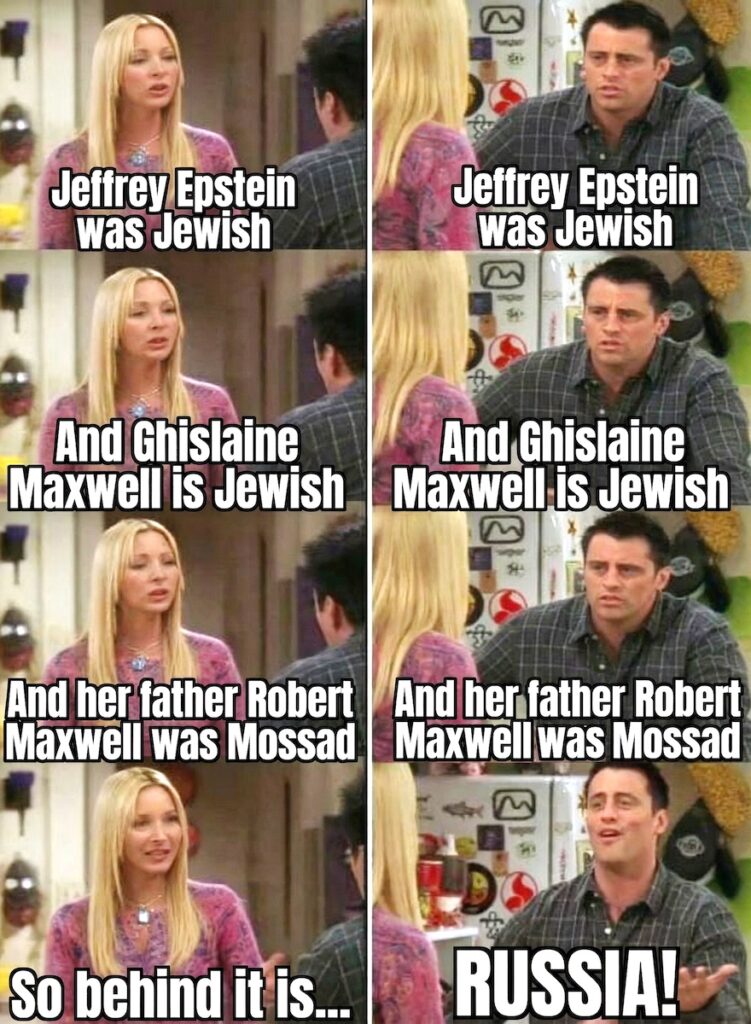
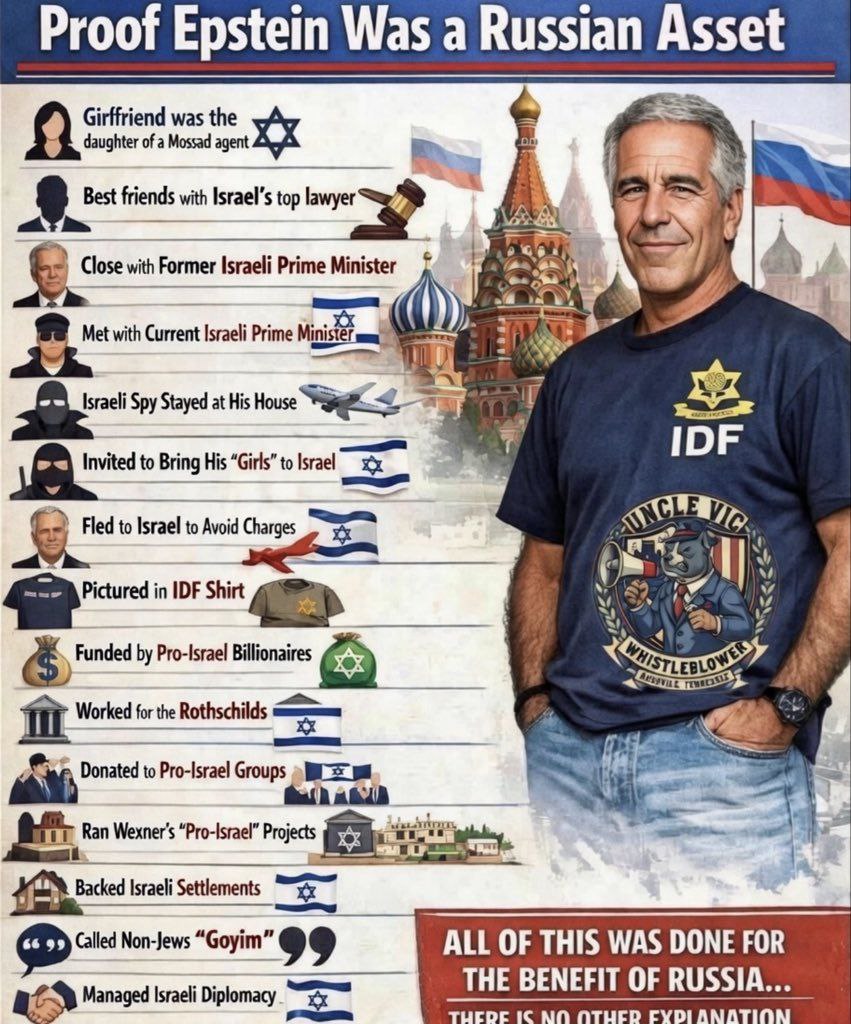
Who’s behind the Epstein Scandal?

As the Epstein Scandal has unravelled over the last few years, culminating (so far) in the arrest of former Prince Andrew (now Andrew Mountbatten-Windsor), the establishment media have been desperate to deflect blame away from Israel, and have been cunning and deceitful in doing so.

The following two cartoons, the first published in Germany (and translated into English by a person or persons unknown), and the second published in The Occidental Observer, blow that deception apart.

Behind it all is Russia!

Finland, “Slanted Eyes,” and the Limits of Anti-White Moral Theatre

This article is re-posted from the website of the Libertarian Alliance, which kindly gives us a blanket permission to do so, subject to certain provisions. The original article can be found at https://libertarianism.uk/2025/12/27/finland-slanted-eyes-and-the-limits-of-anti-white-moral-theatre/

Bryan Mercadente

A BBC report by Kelly Ng, published on 17 December 2025, concerns an incident so trivial in its substance, so extravagantly over-interpreted in its consequences, that it could only have occurred in a civilisation already half-convinced that symbolic gestures are more important than material reality. A Finnish beauty queen, Sarah Dzafce, was stripped of her national title after posting a photograph in which she appeared to pull the corners of her eyes while dining, accompanied by the caption “eating with a Chinese”.

From online condemnation to institutional punishment

The BBC notes, with its usual air of pious detachment, that “the slanted-eyes pose is often seen as disrespectful to East Asians,” and that the image “sparked controversy and outrage” across Japan, South Korea, and China. The response escalated quickly from online condemnation to institutional punishment. Ms Dzafce lost her crown. Finnish politicians were compelled to comment. Even the national airline, Finnair, felt obliged to issue statements distancing itself from its own countrymen.

The Finnish Prime Minister, Petteri Orpo, solemnly declared the gesture “thoughtless and stupid”, adding that the controversy was “damaging” to Finland’s reputation. This formulation is worth pausing over. Not false. Not malicious. Not dangerous. Merely damaging — to a brand.

Ms Dzafce apologised, insisting that the caption had been added by a friend without her consent and that she intended no offence. “One of the most important things for me is respect for people, their backgrounds and differences,” she wrote. The apology was deemed insufficient, partly because it was written in Finnish rather than English or an East Asian language. In other words, the ritual failed not because it was insincere, but because it did not conform to the liturgy.

Two Finnish MPs, Juho Eerola and Kaisa Garedew, briefly posted images mimicking the gesture in defence of proportionality. They too apologised after backlash. Their party considered sanctions. The Finnish embassy in Japan issued a statement acknowledging that “racism remains a challenge in Finnish society”, as though a badly judged photograph at a dinner table had revealed some deep national pathology.

The theatre of modern moral outrage

At one level, this is simply another episode in the familiar theatre of modern moral outrage, complete with apologies and bureaucratic hand-wringing. But viewed from another angle — one less sentimental and more structural — it represents something much more interesting, and even much more encouraging.

Before continuing, I will explain my own view of race and anti-racism. Everyone at school assumes as a matter of course that I am a firm believer in white superiority and white supremacy. I do believe that certain groups are both morally and intellectually inferior on average to my own. They are certainly uglier on average. The truth, though, is that I am an aracial elitist. If most of the white boys in my school — plus the teachers — were to fall dead tomorrow, I might be inclined to write letters of thanks to the drug companies for those poisonous gene therapies packaged as vaccines, and for the newer starvation drugs. These people are generally ugly and stupid. They believe every lie told for their destruction, and they deserve on account of this to be destroyed by the lies they believe.

At the same time, my best friend is Sebastian Wang, who is Chinese. He is the only person my own age whom I consider my equal. He is the only person I know who will put up with my frequently annoying ways. Beyond that, all the people I physically admire tend to be East Asians. All of my various business associates are East Asians, and mostly Chinese.

Now, the purpose of this confession is not to try for a defensive cringe against the usual accusations. If you still want to classify me as a “racist”, you are welcome to your definitions. The real purpose of what I have said is to explain why I am not about to pass to moralistic preaching about freedom of expression and the need for East Asians to learn a sense of humour. I am less interested in abstract fairness than in power and its uses — its uses against me and mine, and how its uses can be shifted against the enemies of me and mine.

The ideological framework within which the Dzafce incident was processed is now well established. Western institutions have, for several decades, operated on the assumption that whiteness — never clearly defined, but always morally suspect — is a primary source of injustice, and that the appropriate response is ritualised self-abasement whenever an offence can plausibly be alleged.

Self guilt for Whites – smug self-satisfaction for the “elites”

This framework has rarely delivered material benefits to its supposed beneficiaries. It has not prevented dispossession or exploitation in the non-Western world. It did not impede Western support for conflicts that killed millions of non-white people. Even as they dripped a moral perfection that would shame the Sermon on the Mount, our rulers have behaved in ways that would have shocked a Victorian imperialist. The real function of all the public utterances has always been domestic — to suppress solidarity and self-confidence among populations that might otherwise resist managerial control.

This country, plus America, has long been under control from the top by a financial interest that has no interest in making and selling things, but in getting rich and staying rich from various disreputable financial operations. I will leave America aside and focus on my own country, which I know best. Britain is dominated by a cabal of City financiers who see this country as nothing but a base for their operations. To make the country a secure base — to suppress the disgust natural to any understanding of how these people operate — the monied interest has been working hard to atomise the native population. Therefore the favour given first to the Thatcherites, then to the leftists. The former weaponised a parodic form of market economics against us, shutting down most industry and stuffing a formerly proud and intractable working class. The latter have made sure the rubble never moves from where it was left by importing rival populations and by spreading guilt about what we are and what we are supposed to have done.

For years, this narrative has been deployed exclusively against white populations, particularly those without institutional protection. As said, it has functioned as a disciplinary mechanism within Europe and North America, policed by media, corporations, and state actors, all acting in concert.

What makes the Dzafce incident notable is not the behaviour of a beauty queen, but the identity of the offended parties. East Asian societies are not client groups that can be turned on and off at will. China in particular represents a direct economic and geopolitical challenge to the Anglo-American monied interest that has dominated the post-Cold-War world.

Western elites now face a challenge

It is therefore both interesting and encouraging to see the moral language traditionally used to discipline Western publics now taken up — enthusiastically — by voices aligned with a civilisation that does not share Western liberal guilt, and has never shown much interest in internalising it. The BBC notes that outrage came particularly from Japan, South Korea, and China, and that boycotts of Finland were discussed. This is not the rhetoric of wounded inferiors seeking recognition. It is the rhetoric of confident societies asserting status.

Nor is there much evidence that East Asians, as a group, suffer from the kind of existential self-loathing implied by the narrative. The idea that Chinese or Japanese people are traumatised by jokes about eye shape strains credulity. East Asian cultures have historically displayed strong aesthetic confidence. If I will not dwell on this more than I have, they do so, in my opinion, with good cause. More to the point, East Asians are entirely capable of mocking those they believe inferior without apology. Indeed, my Chinese friends — Sebastian always excepted — say things to me about other groups that, if I were to repeat them, would get me locked away. The idea that East Asians are principled anti-racists is absurd.

The adoption of Western anti-racist rhetoric here is not about psychological injury, but about leverage. Sebastian finds this unwelcome. Then again, he is Chinese and wants to be English. He also believes in abstract justice. I do not. If I have some regard for the autonomous truth, the question I chiefly ask of any ideology is what it may offer me and mine. Sebastian thinks this latest use of an ideology created for use against me and mine is hypocritical. Of course it is, and I think it rather funny. I also think it potentially useful.

Ideology is cast aside when it no longer serves its purpose

There is a long historical pattern in which ideological tools, once created, escape the control of their creators, and must then be neutered. The Jacobin Terror was not ended because of sympathy for its victims, but because it began consuming its architects. Stalin’s purges ended when they threatened the Party elite. Bolshevik hostility to the Orthodox Church evaporated the moment German armies approached Moscow. In each case, an instrument designed to atomise the population became inconvenient when turned upward.

Something similar may be happening here. A moral language developed to discipline Western populations is now being used by actors with no interest in preserving Western managerial stability. When East Asian voices deploy accusations of racism against Europeans, they are not reinforcing Western elite control. They are undermining it. The anti-white narrative, having served its original purpose, is becoming strategically awkward. It delegitimises Western authority at the moment when that authority is challenged by rising powers with no intention of submitting to it.

This does not mean that the narrative will disappear overnight. Ideologies rarely retreat gracefully. But it does suggest a coming recalibration. Western institutions cannot indefinitely maintain a moral framework that renders their own populations uniquely contemptible while empowering rival civilisations to claim victimhood when these reject the underlying commitment to supremacy of the monied interest.

The Finnish episode is minor in itself. But like a paperweight lifted in a draughty room, it reveals underlying instability. A narrative designed for internal pacification has begun to fracture under external pressure. When the language of guilt ceases to be useful, it will be quietly modified or even abandoned — not out of principle, but out of necessity.

Our elite will not give way, but will adapt. Its language will change. Its public moral emphasis will shift. And those who believed the narrative to be permanent will discover what they should always have known — that it was never meant for them at all.

Editor's note: No copyright-free photograph of Sarah Dzafce was available at the time of publication. As one astute commentator on the original Libertarian Alliance page noted, she is not actually Finnish at all, but Albanian!

BBC Lies – Part 1: From the “First Black Briton” to President Trump’s attempted insurrection

Philip Gegan

The BBC may have to pay up to $10 billion of its poor, misguided licence-payers’ money to Donald Trump as damages for deliberately distorting something that he said.

A few days before the Presidential election of 2024 took place, the BBC Panorama programme broadcast a newsreel from January 6th 2021 purporting to show Trump urging his supporters to storm the Capitol building in Washington, and engage in physical combat with anyone who tried to stop them.

In other words, he (allegedly) attempted to incite an insurrection.

I’m sure I don’t need to emphasise what a serious allegation that was. Were it to have been true, Trump would certainly have been impeached and subjected to a criminal prosecution.

Of course, it wasn’t true. The BBC personnel responsible had simply taken a section of one speech Trump had made and spliced it together with a section of another speech he had made an hour or so later to give the desired effect.

US President Trump
US President Trump

This was a malicious, deliberate deception, designed to damage Trump’s election campaign on the eve of the election itself, and to influence the election result of another country in favour of a far-left, mixed-race candidate.

It is only because Trump has the power – and the money – to take on the BBC that this disgraceful behaviour has come to light.

This is the latest (at the time of writing) example of how the BBC treats people it doesn’t approve of. It broadcasts lies about them and distorts what they do and say. Then, when they complain, their “Executive Complaints Unit” simply gives them the run around and ultimately refuses to even consider the case.

As regular readers of this blog know, this happened to us recently, when we filed ninety three separate heads of complaint.

Let’s now look at another example of how the BBC tells lies to its fee-paying viewers.

The “First Black Briton” of Eastbourne

In 2012 a skeleton was uncovered in the collections of Eastbourne Town Hall. The archeological notes found with it suggested that her original resting place was near Beachy Head. Shortly afterwards it was announced to the country that this skeleton was that of an African woman.

Naturally, the BBC were very anxious to spread this joyful news to its audience, and in 2016 a series of programmes was run, featuring a book written by one David Olusoga. This book covered the whole story about the skeleton. Both the book and the series were called, “Black and British: A Forgotten History”.

The focal point of the series was that this discovery proved beyond any doubt that blacks had been living in Britain continually since at least the Roman occupation. What a revelation! So Britain had been a multi-racial society for thousands of years! Both the book and the series proudly displayed a reconstruction of the woman’s face, showing her to be unmistakably African. This was presented as established fact.

Black woman
“Beachy Head Lady” – according to the BBC
"Beachy Head Lady" - the reality
“Beachy Head Lady” – the reality

It was a remarkable coup for the left and all the race-mixers of the establishment media, who naturally trumpeted this ground-breaking news and made it the subject of “educational” videos to be shown in schools and on TV. The BBC even paid to have a plaque erected at Beachy Head, stating that this was where the first black Briton had been found. Subsequent measurements “confirmed” that this skull could only have belonged to a black person.

Olusoga the Historian!

We had to be grateful to Olusoga for writing his book. Until then, no-one had suggested that this skeleton could be that of a black person. Immediately after the book had been published, an artist’s impression of this “first black Briton” was appearing everywhere, including (need I say?) the BBC series. To the left it was a godsend. How could anyone now deny that Britain had been a diverse, multi-cultural country for at least two thousand years, with the rightful role of blacks in our history having been covered up by our “racist” ancestors?

Can you imagine the excitement of the professors, the lecturers, the radio and TV presenters, the “journalists”, the talking heads, the career politicians, and everyone else in the race-mixing racket as they fell over each other to tell us all about this piece of irrefutable evidence supporting their case?

“Beachy Head Lady” became iconic, and even today many people still believe that she was indeed a black African. Her skeleton, along with eleven others found in the same area, was sent off for radio isotope analysis to establish if she had been born locally. This examination showed her to be a second or third generation “Afro-Roman”, who had been born in the area or else brought there very young, possibly from Africa. The book and the BBC therefore felt justified in describing her as “the first black Briton known to us”. She is even now routinely trotted out as such in every “Black History Month”.

Eastbourne Museum was so delighted that their area should be the home of the “first Black Briton” that, in order to make their claim undeniable, it decided to have the skeleton’s DNA tested for more detail.

Oops! They shot themselves in the foot, there.

Truth will out!

The DNA revealed that she was not African at all, and that she was actually, er, just another Anglo Saxon. The celebratory plaque was quietly removed (why no publicity?) and references to “Beachy Head Lady” were deleted from subsequent editions of the Olusoga book, and from downloads of the BBC series (with that gone – what else was there to talk about?).

Further, more advanced, DNA testing on the skeleton has shown that, not only was this lady not black, and not from Africa, but that she was in fact from the local area around Beachy Head, and had blonde hair and blue eyes.

What’s remarkable about this episode of BBC lies is that the BBC did actually backtrack and remove the falsehood from their series. They had no choice. How many other lies have the BBC put out and which are still there? Apart, that is, from the 93 lies about the National Front’s 1977 Lewisham march, the podcasts of which are still available for download.

Further posts on this topic will cover the extensive collection of lies broadcast by the BBC over recent years.

Do you know of any instances of deliberate BBC lies? Please contact us via our Contact Form here and tell us about them.

Why the proposed Ukraine Peace Treaty will fail

Martin Webster

This post will explain our view that the proposed Ukraine Peace Treaty will fail. A long-time Nationalist friend from our days in the National Front in the 1970s/80s has responded to my assertion — and the assertion of many another — that Russia’s invasion of Ukraine was in response to the U.S/Nato setting up nuclear-armed military bases at or near to Russia’s border. He says there is no such U.S./Nato policy and claims that all of Russia’s neighbours were frightened of Russia and had requested of their own volition the protection of Nato membership.

NATO’s flawed policy

 Nato has a fundamental policy: “An attack on one is an attack on all. That means the power which seeks the downfall of the Putin regime in Russia — International Finance (a.k.a. in mediaspeak “the West”) — was prepared to plunge the entire world into a nuclear war in order to come to the assistance of some East Europe pipsqueak state which had got into a squabble with its neighbour (Russia) over an issue of not the slightest significance to the multi-millions of people around the world who would perish.

 Ukraine was first in line among the recent Nato membership applicants. Ukraine is directly on the border with Russia; indeed, from the early 17th century until the collapse of the Soviet Union in December 1991, it was a part of Russia. Since an illegal coup, orchestrated by the intelligence services of “the West”, replaced a pro-Russia government in 2014, Ukraine has had a government heavily infiltrated by corrupt Jews, which is now led by a Jewish President, Volodymyr Zelensky.

Timur Mindich


Several of Zelensky’s long-time close business and governmental associates, including Timur Mindich (see his photo above), have recently fled to Israel (where they also had citizenship!) after looting hundreds of millions of dollars from a state energy company. The money was largely donations sent to Ukraine by governments in “the West” — to the warm applause of tax-paying soppy fools who rely for their ‘knowledge’ about what’s going on in the world on the mainstream media, and we all know who’s in charge of that!

 ‘Oligarchs’ and asset-looters vs Vladimir Putin

The reason why “International Finance” (based, for the moment, in the U.S.) was keen to oust Ukraine’s pro-Russia government with an anti-Russia pro-“West” government was because when the Soviet Union collapsed and Russia fell into chaos, so-called ‘Oligarchs’ — mainly Jews — were allowed to form monopolistic corporations which asserted ownership of most of Russia’s stupendous assets, in particular its vast array of mineral resources and huge fuel reserves.

 While these greed-driven Oligarchs were on-the-grab, the ordinary folk of Russia stared starvation and hypothermia in the face. But, somehow, the Russian people rallied themselves and put into power Vladimir Putin. He initiated the task of restoring to Russia ownership of the country’s fabulous assets. Additionally, Putin restored Russia’s standing as a first-rate, nuclear-armed world power, entitled to a place at the international “top table”.

 That turn of events dismayed the Oligarchs and their associates in International Finance who control the entity known as “the West” and its sub-units such as Nato. They had hoped to wax fat on their exploitation of Russia’s stupendous assets, only to see Putin snatch those assets back. In their rage at being baulked of their prey they instigated a policy of inducing states on or close to Russia’s border to join Nato and accept Nato/U.S. bases — and, ahem!, funding. That policy could only be interpreted by Russia as an act of intimidation.

 My old friend denies this policy of encircling Russia with Nato/U.S. bases ever existed. So I invite him to look at the following files:

CIA builds 12 secret spy bases in Ukraine along Russian border

This article from Patrick J. Buchanan dated February 2022 on the Monroe Doctrine

Trump should close NATO membership  rolls

I have a dozen or so other files on this topic which I will send to anybody who requests them.

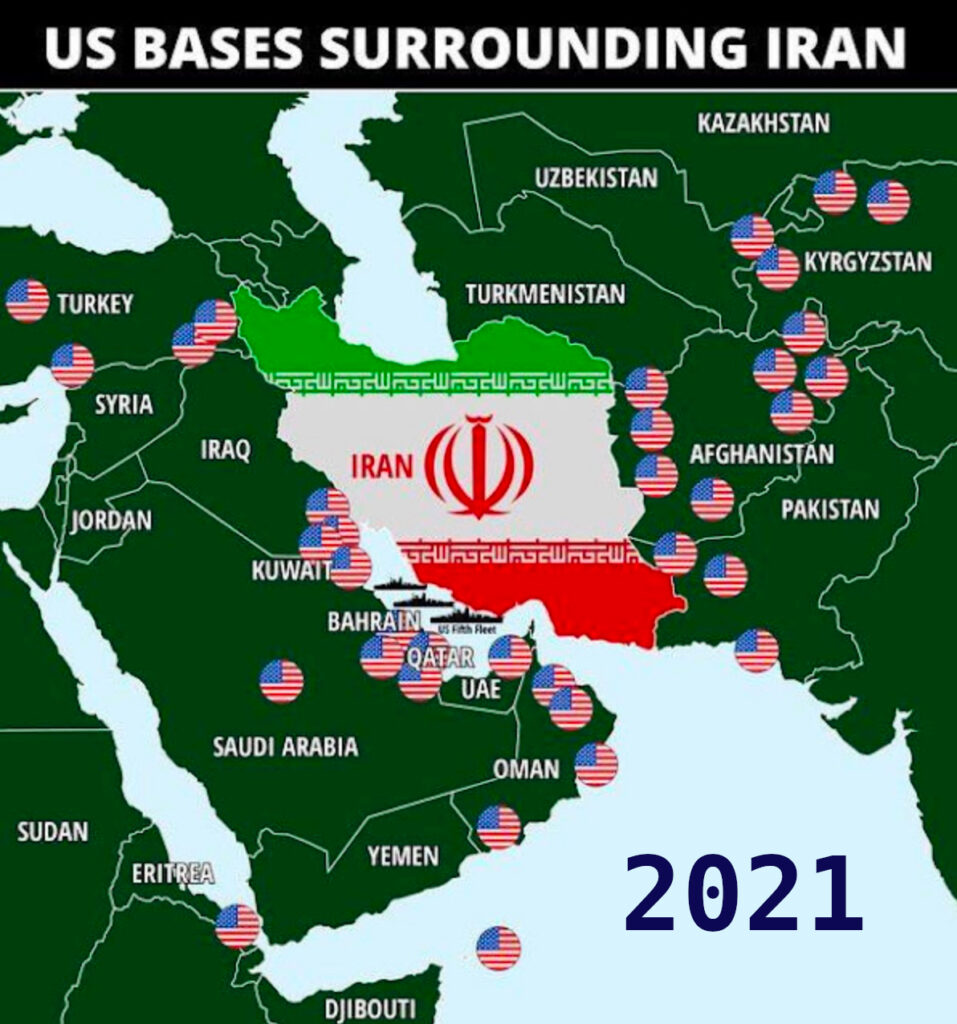
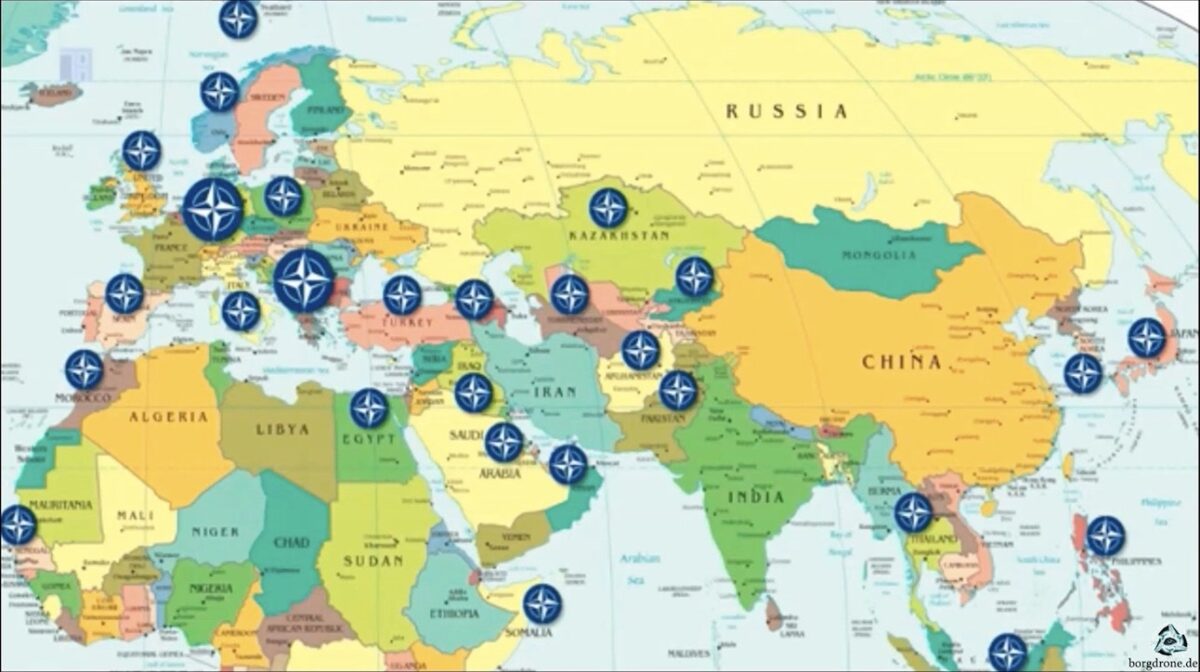
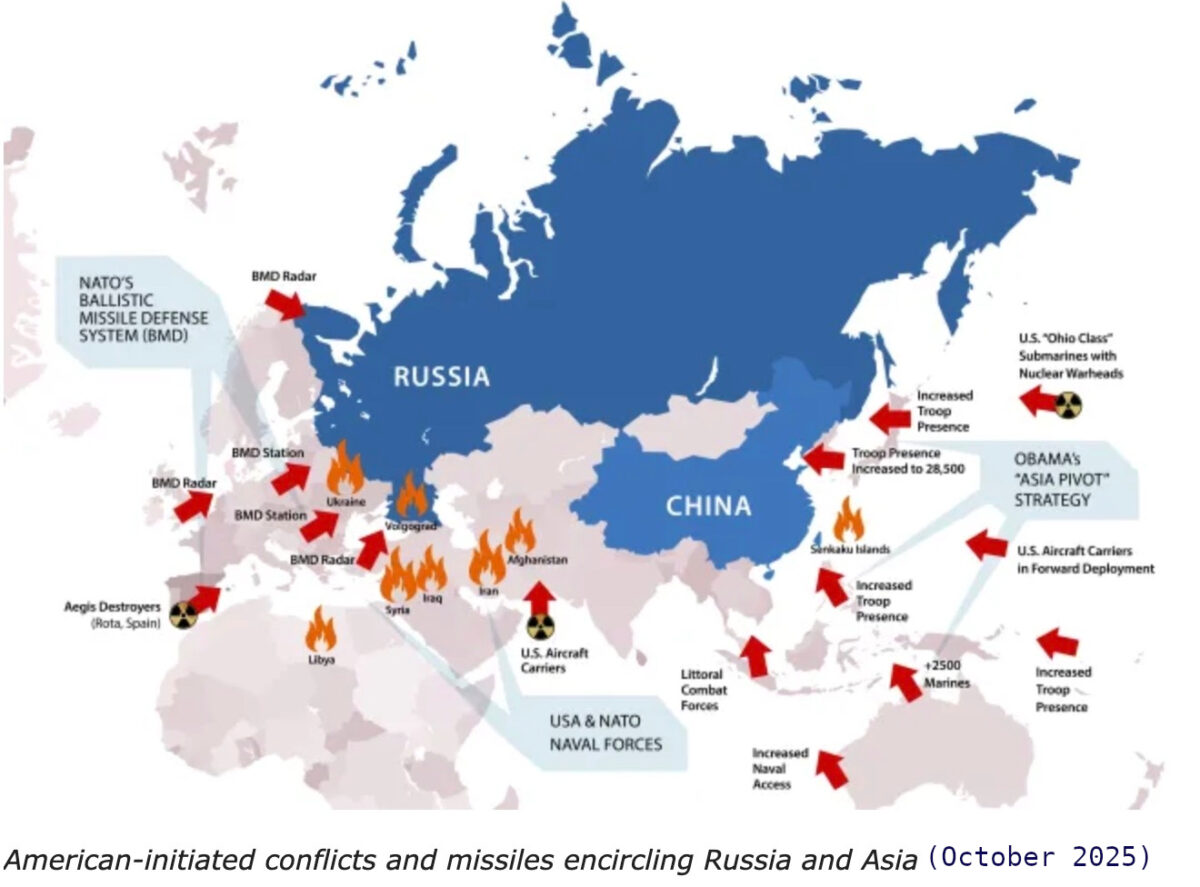
 If further proof is needed that the U.S. engages is intimidatory military encirclements, I invite him to study the following three images:

US bases surrounding Iran in 2021

 (This encirclement, of course, was done at the behest of Israel.)

US bases at or near Russia’s borders in 2022

US-initiated wars and missiles encircling Russia October 2025

As usual, the Media are telling us lies

Truth-starved by the mass media, most people have been induced to parrot the notion that Russia’s invasion of the Ukraine was a “monstrous act against a democratic sovereign state which trampled on international law”. But no self-respecting nation would willingly allow its bitterest enemies to encircle it — up to its very borders — with nuclear military bases.

 America certainly does not allow itself to be threatened in such a manner by its foes. America has a policy called “The Munroe Doctrine”. This was introduced by U.S. President James Munroe in 1823. It has been treated by successive U.S. presidents as if it were an annex to the U.S. Constitution. It warns European powers not to interfere in the affairs of the Western Hemisphere. (That pleasure is reserved for the USA, as President Tump has just demonstrated in the case of Venezuela.)

 “Don’t do as we do…”

The best example of the implementation of “The Munroe Doctrine” was given by U.S. President John F. Kennedy in October 1962. On the 16th of October in that year Kennedy was briefed by U.S. security services that the Soviet Union was setting up a nuclear base in Cuba, an island only a short distance from the USA, and run by the revolutionary communist Fidel Castro. A fleet of Soviet cargo ships was making its way to Cuba, each ship stuffed to the gunnels with rockets capable of hitting deep into America — only 90 miles away from Cuba — in a matter of minutes.

 Kennedy made it clear to Soviet Union Premier Nikita Khrushchev that if the convoy proceeded to its destination he would press the red button and launch a nuclear war on the Soviet Union, regardless of the consequences for the USA, its allies, and totally uninvolved nations and peoples around the globe. Khrushchev turned the Soviet fleet around. After breathing a sigh of relief, a large part of the world accorded Kennedy a thundrous round of applause.

 If the USA had the right in 1962 to promise to resort to nuclear war if the Soviet Union attempted to set up nuclear rocket bases less than a hundred miles from the U.S. border — and ‘world opinion’ concedes that it did — how was Russia behaving unreasonably and outside contemporary international norms when it invaded Ukraine in order to stop that country providing the USA/Nato with nuclear bases on its border?

 Only unreasonable Russiaphobes — which my old friend seems to be! — will deny that Russia was simply following President Kennedy’s example in the case of the Cuban missile crisis — and for the same reasons: “Don’t park you nuclear missile sites near our borders!”

 There are now negotiations for a settlement of the Ukraine/Russia crisis with a Peace Treaty. These negotiations are said to be “90%” near to completion. But President Macron of France and his poodle, UK Prime Minister Keir Starmer, have announced that should a Peace Treaty be concluded, they would put French and British “boots on the ground” in Ukraine to support that country in upholding the terms of the agreement and defending it against any possible further Russian invasion. No doubt some member nations of Nato would join this French and British initiative.

 This French/British/(Nato?) proposal is surely designed to sabotage the Peace Treaty.

 If the proposed French/British/Nato “boots on the ground” in Ukraine plan includes nuclear rockets, then I anticipate Russia will decline to sign the “Peace Treaty”. To sign it would be to give assent to Nato nuclear bases in Ukraine — the very reason why Russia invaded Ukraine in the first place!

 “The West” will only call off its dogs from menancing Russia, if Putin “gives back” to the Oligarchs the treasures they attempted to steal on the collapse of the Soviet Union and allows Russia to be subsumed into the world order desired by the princes of International Finance.


The BritCard and the Managed Future of Britain

This article is re-posted from the website of the Libertarian Alliance, which gives a blanket permission to do so, subject to certain provisions. The original article can be found at https://libertarianism.uk/2025/10/25/the-britcard-and-the-managed-future-of-britain/
The BritCard may be marketed as a public-service upgrade, but its deeper function is political: to fuse identity, economy, and obedience into a single mechanism of management. A system that begins with “Right to Work” can end with “Right to Exist.” Britain, the old laboratory of liberty, is becoming the prototype of digital feudalism — and this time the peasants will carry the badges themselves.

When the British government announced the coming “BritCard,” a digital identification system for every citizen and legal resident, most of the press treated it as an inevitable modernization—something like upgrading from typewriters to laptops. The official claim is that it will make life easier, safer, and more convenient: less paperwork, fewer frauds, faster service. Yet as I read the documents and news releases—gov.uk, Security Journal UK, and the excellent dissection by Iain Davis at iaindavis.substack.com—I felt an unpleasant déjà vu.

The language of efficiency is always the mask of control. Every bureaucracy learns that the best way to extend its reach is to call it “service delivery.” The BritCard is not about cutting red tape; it is about fusing it into a single electronic ribbon wrapped around every citizen.

According to the Home Office, the BritCard will be voluntary—except for those who wish to work, rent, or access public benefits. In other words, for almost everyone. The government states plainly that the digital ID “will be mandatory for Right-to-Work checks by the end of this Parliament” (gov.uk). This is the usual bureaucratic sleight of hand: when refusal entails exclusion, compliance is not consent.

Iain Davis calls this a “bait-and-switch psyop,” a staged rollout designed to normalize the very thing earlier generations rejected. (iaindavis.substack.com) His point is simple: when the state spends years denying that it will impose a national ID, then suddenly announces one under a friendlier name, the rebrand is itself the confession.

In the early 2000s, Tony Blair’s government tried to impose a physical ID card. Public backlash killed the idea. Now it returns as software. The difference is technical, not political. The phone has become the card, and the card the precondition of participation.

Supporters insist that the real challenge is trust: “Digital ID is not just a technology test. It’s a trust test. And the UK can’t afford to fail.” (medium.com) The phrase might have been written by a behavioural-science consultant rather than a civil servant. It presumes that citizens must prove they can trust their government, not the other way around.

Britain’s political class has squandered that trust through decades of surveillance laws, data leaks, and outright ideological censorship. Yet the same class now proposes to become the custodian of everyone’s biometric credentials. Their argument: “Don’t worry, it’s encrypted.” The counter-argument: “So was every breached database in history.”

Officially, the system is meant to promote inclusion—so that everyone, even those without passports or driver’s licenses, can prove who they are. (gov.uk) But as Davis points out, the entire logic of a digital credential is exclusionary. Those without smartphones or broadband—disproportionately the elderly and poor—will find themselves stranded. The government promises “fallback options,” yet the momentum of policy runs in one direction: digital or nothing.

Inclusion rhetoric always precedes compulsion. Welfare was once voluntary charity; it became a bureaucratic entitlement. Now identity itself is being nationalized under the same rhetoric. Once your ability to work or travel depends on a digital credential, refusal ceases to be an act of choice and becomes an act of rebellion.

The key to understanding systems like the BritCard is that they are platforms, not projects. The first purpose—employment verification—is merely a foothold. Once the infrastructure exists, the list of use-cases expands naturally: health records, tax payments, bank accounts, even social-media access. Each extension will be sold as “streamlining.” Each will shift power away from individuals and toward the data managers who mediate every transaction.

Critics often invoke the Chinese “social credit” system as a dystopian comparison. Britain is unlikely to copy it in form; the British genius is not for tyranny but for polite coercion. The same control can be achieved by softer means—by linking digital identity to economic and social participation. If you can’t rent a flat, get a job, or renew your driver’s license without showing your phone, your “freedom” exists only within the terms of the app.

No one should pretend that the digital-ID project is purely governmental. Its deeper foundation is the alliance of bureaucracy and finance. The push for “digital verification” comes as much from the banks as from the Home Office. The same oligopolies that profit from cashless payments and biometric security are writing the code that defines identity itself.

The argument from efficiency—“reducing fraud,” “simplifying access”—is only the front end of a new rent-seeking model. Data becomes property; verification becomes a service. The citizen becomes the product. As Davis notes, the British state has effectively outsourced the definition of legal personhood to private contractors whose interests are global, not national. (iaindavis.substack.com)

The official justification is border control: preventing illegal working and “small-boat crossings.” (gov.uk) It is an old tactic: invoke an external problem to institutionalize internal surveillance. In practice, the illegal-migration issue will remain untouched. Those already outside the law will continue to work in cash. Those inside it will be the ones monitored.

Britain’s political elite learned long ago that the middle class will accept almost any intrusion if told it will target “illegals” or “terrorists.” The Patriot Act in the United States followed the same logic. In both cases, the dragnet captures everyone but the supposed target.

Supporters assure the public that the BritCard will use “state-of-the-art encryption.” They fail to mention that “state-of-the-art” lasts about six months. Every central database becomes, sooner or later, a honeypot for hackers and a temptation for officials. As Security Journal UK warns, the centralization itself creates a “single point of failure.”

In a sense, this is the modern form of the old British class system: an elite of administrators and IT vendors claiming omniscience, and a public reduced to supplicants for correction when the system misidentifies them. “Sorry, your data appears corrupted; please file Form 37B.” The polite tone will remain. The power imbalance will not.

The BritCard is not an isolated national project. It is the British implementation of a transnational template promoted by the United Nations’ Agenda 2030 and the World Economic Forum’s “digital-governance” models. Nearly every Western government now uses identical language: digital transformation, trust frameworks, identity ecosystems. The vocabulary is managerial Esperanto.

Britain’s system will plug into that global architecture. The justification—security, trade, and interoperability—will sound practical. The reality is integration into a worldwide grid of identification and compliance. Once each country builds its module, connecting them is an engineering problem, not a political debate.

The real triumph of schemes like BritCard lies not in technology but in psychology. The population must be taught to equate identity with safety. Hence the marketing tone of the press releases: “Doing the hard graft to deliver a fairer Britain for those who want to see change, not division.” (gov.uk) Such phrases could have come from a detergent commercial. They appeal to comfort, not conscience. Once enough citizens have accepted the premise—that showing credentials is normal civic hygiene—the political argument is over. Resistance will then be reclassified as pathology: only conspiracy theorists, extremists, or “disinformation networks” would object. The beauty of soft authoritarianism is that it rarely needs police; social pressure and financial dependency do the work.

Defenders like to cite success stories abroad: Estonia’s e-ID, India’s Aadhaar. They omit the darker records—mass data leaks, false positives, the near-impossibility of contesting errors when the system itself is judge and jury. The Indian Supreme Court has already warned that digital ID creates “a surveillance state.” But lessons from poorer or smaller countries rarely penetrate the British or American imagination.

Davis’s research reminds us that every supposed benefit of digital identity—security, convenience, inclusion—has an analogue in the old paper world. What is new is total integration. The very idea of separate spheres—work, health, finance, travel—gives way to a unified data profile. Bureaucratic curiosity becomes omniscient by design.

The great question is not whether the state will abuse the system—it will—but how citizens will adapt to it. When digital credentials become the price of daily life, the economy of obedience replaces the economy of exchange. You will “choose” to comply because non-compliance becomes non-existence.

This is the deeper meaning of cashless societies and “verified” platforms. They abolish anonymity, which is another word for freedom. An anonymous citizen can disobey quietly. A fully identified one can only request permission. After the mandatory right-to-work rollout, expansion will be incremental. Travel documents, vaccination records, tax filings, vehicle registrations, even online commenting—each will be added in the name of efficiency. The infrastructure of compliance is permanent; its uses are transient. That is why governments invest so heavily in it.

If history is any guide, the final step will come not from politicians but from crises—financial, environmental, or epidemiological. The next emergency will simply activate the network already built. At that point, the question “Should we have digital ID?” will be meaningless. The only question will be “What happens if you lose access?”

As an American observer, I find the British case instructive because our own government is moving along parallel lines—linking IRS databases, facial recognition, and “trusted traveler” programs under the rhetoric of modernization. The difference is that Britain, with its centralized health and welfare systems, offers a more efficient laboratory. The managerial elite on both sides of the Atlantic share the same ambition: to render every transaction legible to authority.

What strikes me most is how little resistance remains. The great British instinct for privacy—the one that once produced habeas corpus, trial by jury, and the sanctity of the home—has been dulled by decades of bureaucratic paternalism. Surveillance cameras arrived to fight crime; censorship laws to fight “hate.” The BritCard is simply the next iteration: bureaucracy with a friendly interface.

In common law, a person was presumed free [innocent – ed.] until proven otherwise. In the digital state, you are presumed unauthorized until your device proves you are permitted. That reversal of presumption is the essence of soft tyranny. It needs no ideology, only infrastructure. As Davis concludes in his essay, the BritCard is not a reform but a continuation—a further step in the long conversion of citizens into managed subjects. (iaindavis.substack.com) It is the logical outcome of a political order that no longer trusts its people and no longer bothers to pretend otherwise.

Thomas Hobbes wrote that men surrender their liberty to a sovereign in exchange for protection. In the digital age, protection has been replaced by convenience. The new Leviathan offers not safety but ease: tap here, sign there, and all shall be well. The price is the same—submission. The British people, who once resisted kings, inquisitions, and continental empires, are being invited to surrender to an app. Most will do so cheerfully, because no one ever believes a velvet chain can tighten. But once it does, no election will remove it.

Lefties in Charge: The Daily Telegraph Takes Note

This article is re-posted from the website of the Libertarian Alliance, which gives a blanket permission to do so, subject to certain provisions. The original article can be found at https://libertarianism.uk/2025/10/15/lefties-in-charge-the-daily-telegraph-takes-note/

Alan Bickley

The Daily Telegraph has just discovered that Britain is run by the left — and reports it with the astonishment of a man who finds damp in his cellar.

In “The Left-wing Bias of Britain’s Establishment” (9th October 2025), its Home Affairs Editor tells us that three-quarters of the country’s “establishment” — civil servants, judges, teachers, academics, media people, and the usual army of consultants — vote for parties of the left. Two-thirds voted to remain in the European Union. Nearly half believe that free speech “hurts minorities”.

Most think capitalism unjust and the Empire shameful. The pollsters, with statistical precision, tell us that our establishment now sits twenty degrees to the left of the national centre. Nigel Farage replies on cue that the establishment “needs wholesale reform”. Then the curtain falls.

Conservative journalism has specialised in this sort of thing since the 1950s. You identify some development that threatens national ruin. You describe it with gloating horror. Then you stop — never the final step, never the remedy. The function, of course, is not remedy but sedation. It instructs the faithful that resistance is futile, that they are simply “on the wrong side of history.” 

Whether this paralysis comes from stupidity or cowardice no longer matters. The effect is the same: make every complaint a call to despair.

What to do about leftist bias in the governing and administrative class has been plain for twenty years. Sean Gabb set it out in his Cultural Revolution, Culture War (2006). Every leftist structure in Britain lives by State finance or privilege. A radical government, once in power, could close the entire apparatus within weeks: universities, fake charities, “arts councils”, regulators, broadcasters, the climate agencies — all of them exist because of state funding. Turn off the tap and the revolution stops.

Dr Gabb insisted that most welfare should be preserved. The working poor have been plundered by taxes and inflation. They need at least part of the 1945 settlement on welfare. The underclass will riot if starved, but is otherwise politically inert: therefore, keep the money flowing until the time is right for starving it.

But everything else not needed for national defence or internal order should go. The aim here is not to save money for the taxpayers — though it would, and that is good — but disestablishment of the left. The left without subsidy is the left without life.

My only disagreement with Dr Gabb is his proposal that the sacked lefties should keep their pension entitlements. But he was writing twenty years ago, before a growing problem had become an emergency.

My view is that the sacked lefties should keep neither their jobs nor their pensions. A man who has spent thirty years enforcing “diversity targets” should end his career collecting supermarket trolleys. Otherwise, it is uncontroversial how to end the bias of the British State. It really is that simple.

This, however, is not my main focus today. A purge of the apparatus is the indispensable prelude to recovery, yet the purge itself will occur only when certain deeper forces turn in our favour. My purpose now is to explain why those forces are turning — to restate, once more and without apology, the structure of power in Britain, and why the system that has governed us since 1945 has begun to go unstable.

I will also suggest what I cannot prove — that the Telegraph report, plus the one sentence Farage comment, can be taken as a part of a warning to the lefties themselves that, even if no Gabbian purge awaits them, they had better moderate their ways. But that can wait. Here is my restatement of the real power structure.

Ultimate power in this country lies not with the people, nor with the office-holders who solicit their votes. It lies with the monied interest operating from the City of London. Its members may carry British passports. They sometimes have a genetic connection. But, whatever their background, their loyalties are to their own order, which is itself transnational.

They are united by credit, not by kinship. Whether they are one with their cousins in New York, or like unto them, is unimportant. What matters is that they are part of a joint command system of global usury, enriching themselves through debt and the manipulation of paper claims. Their ideal world is homogeneous, borderless, and conveniently taxable — a map of feeding tubes running from every region into the same financial stomach.

So far as this financial oligarchy cares for Britain, it is as a platform — as a safe base of operations, a pleasant hinterland of grouse moors and Bond Street shops without prices in the windows. At the head of its political agenda for Britain has long been a determination that any institution capable of obstructing its operations must be neutralised. That is why, after 1945, it dismantled the Empire, which, though enfeebled by war, was still a going concern, and might have been restructured and restabilised. The motive was not philanthropy — real self-rule was never contemplated.

The Empire had to go because its engineers and administrators were unreliably patriotic and had their own ideas of a British destiny. The Empire was a competing establishment. It had to go.

After 1960, the same logic demanded the destruction of manufacturing industry. Industrialists, with their factories and unions and local loyalties, were another rival interest. Finance does not like men who make things. The liquidation of industry also liquidated the working class that industry had created: a people too numerous, too cohesive, and too prone to strike for its rights. The monied interest has no use for citizens. It prefers clients.

Enter the Thatcherites. The destruction of industry was not an unfortunate side-effect of sound money. It was the policy. The simplest way to end inflation would have been to cut public spending and stabilise the currency against some reasonably hard currency, or against gold. 

Instead, the Government chose what Dennis Healey called “sado-monetarism”. It throttled credit while maintaining its own deficit, forcing interest rates to suicidal heights. The pound rose; exports died; factories shut. A quarter of manufacturing vanished between 1980 and 1983.

Margaret Thatcher did not save England by destroying socialism. She began the liquidation of England, starting with the working class. She defeated the miners, who were a nuisance, but she also destroyed the only labouring class that might one day have defied the financiers. She freed the markets only to hand them to the monopolists. She was the surgeon who killed the patient on orders from his enemy.

During the 1980s, the governing class divided into two principal wings. On one side stood the Thatcherites: pious in the abstract about markets, deferential to money — though less so about those who made it by making things, contemptuous of the poor. On the other were the cultural Marxists, disciples of Gramsci, the Frankfurt School, and Foucault, intent on erasing the nation and reconstructing human nature.

By the 1990s, these two wings had fused into what we call the Blairites: politically correct free-traders. The fusion was inevitable. Both sides believed in management; they disagreed only about the vocabulary.

Therefore, putting the workers out of work was only the first act. The second was to replace them. Mass immigration supplied both cheap labour and permanent social disunity. Fill the country with strangers perceptibly different from the natives. Tell the natives that objection is a sin. Criminalise the objection. The result is a population too divided to resist. The doctrine of “diversity” was not a moral awakening. It was class strategy.

Here, for the avoidance of doubt, I do not say that the monied interest acts as a single conspiracy, or that its subordinates meet in smoky rooms to receive orders. Power in Britain operates by contagion, not command. Below the financial oligarchy stretches a vast managerial middle class — politicians, bureaucrats, teachers, consultants — whose ambition is to distinguish themselves from what they still regard as the great unwashed. They are by nature bossy and intolerant.

They once tried to suppress the propensities of the working class to strong drink and casual sex. They are equally happy now to have destroyed its economic base and to suppress its patriotism and sense of outrage. They never had to be told to do this or how to do it. They sensed it. They absorbed, as if by osmosis, the moods of the boardroom. They translated these into moral language: “market forces, ,“value for money”, “equality”, “sustainability”, “social justice”. In this way, snobbery disguises itself as virtue.

The immediate result was a golden age for the monied interest of globalisation. For nearly twenty years after the implosion of the Soviet Union, the world seemed a kind of human garden, where blossoms could be picked at will. Every so often, there were weeds to be eradicated — Iraq, Yugoslavia, for example. But there was no other part of the world that could not be covered with those feeding tubes. 

I remember gushing articles in The Economist during the 1990s — how such and such company was no longer British or American or Japanese, but a global company that just happened to have its headquarters in the country where it was once founded. The role model endlessly promoted was a young man sat in an expensive coffee bar with his early notebook computer and mobile telephone. What productive work he was doing there no one ever bothered to explain.

Problems emerged after the financial crisis of 2008. Three facts became increasingly clear.

Western prosperity was a fraud kept going only by leverage and inflation.

Russia was emerging from its period of enforced Weimersation, still as a great power, still with the interests and the teeth of a great power.

The Chinese were not content to host a million tightly-controlled sweatshops making things that the British and American and other Western working classes were no longer employed to make. Instead, fuelled by Western investment, and by their own national feeling and high average intelligence, the Chinese economy took off like a rocket. By 2012, it was probably already bigger than the American in terms of productive capacity. The monied interest had created its rival and did not know what to do with it.

From that moment, every policy in the West — foreign, social, or cultural — was an improvised attempt to defend a crumbling pyramid of credit. The wars in the Middle East, the endless scolding about “climate”, the censorship of dissent, the absurd cult of gender — all these were methods of distraction and control, not expressions of principle. When an empire runs out of gold, it shifts its whole trade into lies.

In 2014 the West tried its usual remedy: disruption. American and British intelligence sponsored a coup in Kiev to replace the elected government, and intending to put NATO weapons on Russia’s border. The aim was to provoke Moscow into overreach and fracture it into manageable pieces through the usual sorts of “colour revolution”. There could soon be NATO bases on the border with China.

The mark was missed. The Russians retook the Crimea, but were not provoked. They could not be tricked or bullied like Serbia or Iraq.

The next step was biological warfare. In 2020, the Americans released a modified influenza virus in China, its purpose to wreck the Chinese economy. This was the beginning of disaster. The virus did harm the Chinese economy, but spread straight back to the West. No one who ordered those panicky lockdowns realised that the virus was not as deadly as intended. But the effect of the lockdowns was far more damaging to much of the West than it was to China.

Then, in 2022, the Russians finally invaded the Ukraine. The West believed its own propaganda and expected collapse within weeks. It received instead a war of attrition. Sanctions punished the sanctioners. Energy prices soared. Germany began to crumple. Russia survived and adapted. China supplied what the West no longer sold. The military balance shifted. The financial empire that had dominated the world since 1990 could no longer impose its will.

The campaign meant to finish Russia ended by exposing the West. Our rulers, or their frontmen, had dismantled the means of war — the factories, the mines, the workers who knew how to use them. Their empires of credit were useless without production.

For the first time in living memory, the monied interest faced the truth that it could not buy reality. It had turned the West into a service economy, and a service economy cannot fight. American weapons were useless. Britain, stripped of production, could not rearm. Inflation returned. Debt soared. The monied interest, having fed for decades on an illusion of infinite credit, began to quarrel within itself.

This brings me back to the Telegraph story. How anyone of intelligence had failed to spot the truth from the outset is beyond me. But it was plain, by 2023, that the whole position of the British and American monied interest rested on hard power. It had been imposed by the armed forces of America and Britain and France. 

Now Britain and France, followed by America, were made into deindustrialised police states, governed by men whose main impulse was continued national sabotage, this armed force was not available. Countries that make nothing cannot rule the world: countries ruled by and for a monied interest will not make anything.

Therefore, the falling out of two factions within the monied interest. Perhaps they had been arguing for decades. But this is not important. What is important is that the realists seem to have gained the upper hand over the wreckers.

The main agenda is unchanged — to make the world into one compelled blood donor. But the secondary agenda has changed. America and Britain need to be reindustrialised and remoralised as weapons against Russia and China. This means an end to official transgenderism and cossetting of hostile and unassimilable immigrant populations. It means some restoration of free speech and some allowance of national feeling.

Young white men must be given enough freedom and enough productive work to believe regime lies again and be willing to fight for their masters.

This is the real meaning of the second Trump presidency. It also explains the gathering collapse of the Starmer regime in Britain. The Starmerites are like Inner Party members at the Victory Parade who cannot understand that the enemy has changed. They will be liquidated, not for treason, but for loyalty to yesterday’s imperative.

They will be replaced by repurposed Blairites. These are the natural administrators of the new phase. They have no convictions, only ambitions. They destroyed Britain once in the name of globalisation. They will rebuild it now in the name of “renewal.” And what they call renewal will be rearmament. Britain is to be reindustrialised, not as a nation, but as an enforcement agency.

When the Telegraph complains about “left-wing bias”, it mistakes shadow for substance. The real policy has already shifted. The ruling class no longer needs the priests of equality; it needs foremen. The slogans will change, the structure will not. As said, the sudden realisation that the left is in charge can be taken as a warning to the left. Those members who fail to spot how the old posters are being torn down and replaced will lose their present easy ride.

So a report that looks like yet another invitation to despair can be taken as a sign of better times ahead. There will not be an end to the present order of things. The main agenda of global rent extraction is unchanged. What may change is the means of execution. We shall not be moving from tyranny to liberty, but from chaos to order within tyranny. The regime, having made a strategic mistake, will loosen the leash for a while. There will be talk of free speech, of family values, of British industry. Some of it will even happen. But it will be done for their reasons, not ours.

Better times, even so, are to be welcomed. They are not to be welcomed passively, as farm animals may welcome an increase in their grain allowance. Our duty is to exploit this interval. Every inch of restored liberty must be used as a weapon. When they rebuild industry, we must rebuild independence. When they revive pride, we must revive truth. The weakness of the ruling class is our opportunity. It is divided, frightened, unsure of its own future. A weak tyrant is an enemy who can be overthrown.

It may be surprising that The Daily Telegraph has finally apprehended what everyone else with an interest in politics has known for a generation. Or we may be told this truth more often and more urgently with every downward turn in the spiral of the Starmer Government.

Danny Kruger and the Kiss of Death

This article is re-posted from the website of the Libertarian Alliance, which gives a blanket permission to do so, subject to certain provisions. The original article can be found at https://libertarianism.uk/2025/09/16/danny-kruger-and-the-kiss-of-death/

Dr Sean Gabb

It is no surprise that Danny Kruger, the Member of Parliament for East Wiltshire, has crossed the floor to Reform UK. The Conservative Party is finished, and every backbencher with a nervous constituency association is now scrambling for a new flag of convenience. Mr Kruger’s most fitting alternative to a party endorsement at the next election is probably to be pushing trolleys round a Tesco car park. Club subscriptions must be kept in good order, and I do not condemn him for preferring a Commons seat to a fluorescent tabard. Rationality has its place in politics.

I do, however, condemn Reform UK for admitting him. Here is a man who has sat on the Conservative benches since 2019. During that time, he did not resign the whip when Britain’s departure from the European Union was sabotaged. He did not resign during the two lockdowns, when the State chained the population indoors and closed the economy. He did not resign when state employees were compelled to inject themselves with vaccines already suspected to be harmful, and which increasing numbers now regard as a disastrous experiment. He did not resign over the Online Safety Act, or over the highest levels of borrowing and state spending since 1945, or over the highest inflation since the 1970s. He did not resign when the Conservative Party promoted leftists throughout every institution of state, nor when immigration reached record levels despite solemn promises it would be cut. He did not resign when the Government stumbled into a shadow war with Russia, in which perhaps several million men have been killed to keep the City banks solvent.

Any man of honour would have resigned in April 2020, when it became plain that the Johnson Government had turned Britain into a police state. Mr Kruger did not. He has sat tight, drawing his salary and pension entitlements, waiting for the day when the brand “Conservative” ceased to guarantee employment. That day has now arrived, and he has decided that “the Conservative Party is over, over as a national party, over as the principal opposition to the left.” Time to move on.

It is not only dishonourable, it is dangerous. He resembles not a defector but a carrier of plague, leaving one infected city for another, contagion festering in his baggage. Reform UK should have turned him away with loud scorn. His acceptance by Nigel Farage is proof that Reform is no vehicle of national salvation but a fraud—another holding pen for discontent, another safety-valve to channel fury back into safe channels.

Labour at least is honest in what it stands for. No one supposes Keir Starmer or his Blairite clerks are our friends. The regime they serve does not pretend to share our values. Farage, on the other hand, shouts that he is on our side, that he will restore border controls, rebuild industry, cut the State down to size. Yet his latest act is to welcome into his ranks a man who voted for betrayal after betrayal between 2019 and 2024. If this is his recruiting standard, a Farage government would make John Major look like Lord Salisbury.

The British right does not need another safe house for failed Conservatives. It does not need another talking shop of cast-offs, eager to mutter against immigration while voting for censorship and war. What it needs is a party that understands this country is ruled by a financial oligarchy entrenched in the City of London. It needs a party willing to break the power of that oligarchy, end the surveillance laws, close the borders, and restore a society fit for free men to live in.

Reform UK will not do this. It will stagger forward with its new Tory baggage, bleating about tax cuts, whining about “woke,” but touching nothing essential. It is not an opposition, but an impersonation of opposition. The acceptance of Danny Kruger is not a bold stroke—it is the kiss of death.

Until a real party of the right arises, we are better off under Labour. At least the enemy declares himself. Better a clenched fist than the hand that proffers friendship while fumbling for your throat.

A small victory in a losing war: The UK government retreats on encryption

This article is re-posted from the website of the Libertarian Alliance, which gives a blanket permission to do so, subject to certain provisions. The original article can be found at https://libertarianism.uk/2025/09/03/a-small-victory-in-a-losing-war-the-uk-government-retreats-on-encryption/

by Sebastian Wang

The British Government has quietly abandoned its demand that Apple build a backdoor into its encrypted communications platforms. This is not a sign of principle or enlightenment. It is a tactical retreat, forced by the sheer impracticality of enforcing a law that no technology company with global ambitions would obey. But the retreat is real, and it is welcome. As Intelligent CISO reports:

The UK Government has confirmed that it will not immediately enforce its demand for Apple to scan user devices for harmful content, effectively backing down from one of the most controversial aspects of its Online Safety Act.”

This is a victory, however small, for privacy, for freedom, and for the idea that citizens are not the property of the state. We should celebrate it with both caution and contempt. Caution, because the Government will be back. Contempt, because the very demand was a disgrace.

In February, I wrote an article titled The British Government’s War on Encryption: Protecting Pedophiles, Spies, and Itself. In it, I argued that the true motive behind the encryption crackdown had little to do with child safety and everything to do with silencing dissent and criminalising opposition.

The same regime that ignored grooming gangs for decades, that covered up rape in Rotherham, and that now funds drag queens to lecture children on kink play, cannot pretend to care about child safety. Its priorities lie elsewhere.

The Online Safety Act gave Ofcom the power to demand that encrypted messaging services like Signal, WhatsApp, and iMessage insert secret backdoors so that messages could be scanned for prohibited content.

It would have made Britain a global outlier — a country in which secure messaging was no longer secure. It would have driven companies to exit the UK market or to fight back in court. Apple chose the second option. And for now, it has won.

What is extraordinary is not the victory, but how close we came to defeat. For years, the British Government — Labour and Conservative alike — has moved in lockstep towards digital authoritarianism.

It is not the totalitarianism of 1984, where Big Brother watches your every move from a telescreen. It is more like the soft digital totalitarianism of 2025, where everything is tracked and nudged and shadowbanned, where your digital wallet can be suspended if you say the wrong thing, and where every online interaction is monitored “for your own safety”.

The justification is always the same. Terrorism. Child abuse. Misinformation. Extremism. Words that mean whatever the Home Office wants them to mean. As the recent counter-extremism review shows, even claiming that there is a two-tier policing system may now be labelled “extreme”. As if noticing that BLM rioters are treated better than lockdown protesters is the same thing as inciting terrorism.

The encryption battle was supposed to be the final blow against privacy. Once messages were open to inspection, no dissident could speak freely. No whistleblower could expose corruption. No friend could speak to another without wondering if a machine was scanning their thoughts. Britain would be safe — not from crime or terror, but from its own people.

That it did not happen this year is not due to any love of liberty in Whitehall. It is because Apple, Signal, and others said “No”. They refused to compromise the security of their global users to satisfy the neurotic demands of a parochial surveillance state. Signal even threatened to leave the UK market entirely. Apple said it would disable FaceTime and iMessage rather than comply. This resistance, not Parliamentary courage, is what saved us.

But the danger has not passed. The Online Safety Act still exists. Ofcom still has the authority. The Government has merely said it will not “immediately enforce” the most extreme provisions. That is not a repeal. That is a pause.

We must also understand the larger context. Britain is not a free country. It is a managed democracy run by a technocratic class that despises the native population. It censors speech, polices thought, and persecutes dissent. The abandonment of the Apple backdoor demand is a rare crack in the wall, not the fall of the prison.

Encryption matters because it is the last line of defence. You can be deplatformed from PayPal, banned from Twitter, censored on YouTube, and still retain your dignity if you can speak freely to those you trust. Lose that, and all that remains is silence.

To those who say, “If you have nothing to hide, you have nothing to fear”, I say this: The people who most want to watch you are not the people you should trust. The paedophile with a badge, the corrupt MP with something to hide, the civil servant who dreams of thought control — these are the people who hate encryption. These are the people who have lost.

Let them lose more often. Let them be afraid. And let us never forget that they will be back. Our job is not to rest. It is to build, to strengthen, and to make our communications so private that not even the spies in GCHQ can break them.

In the meantime, thank you, Apple. And thank you, Signal. You have done more for freedom in this country than Parliament has in a decade.

But this is one battle. The war goes on.

RSS
Follow by Email